The Path to a Future: Security

Part 5 in the serialization of the The Path to A Future. Real security.

A new section will be posted every 2 weeks during 2011. Enjoy!
If you want to get a free PDF of the book go to http://www.standardsoflife.org/thepathtoafuture.

To reach our destination we need the full participation and maximum contribution of every person. When we talk about security on The Path to a Future, what we mean is the personal, material security of each person. Our personal participation requires that we are not wondering where our next meal will come from, or if we will have a roof over our heads when we get too old to build a house. If people are insecure about their own futures, they will not lift their sights enough to act in the best interests of everyone and the planet.

Population control, mutual cooperation and environmental management are all dependant on the personal security of each and every person in the world. The cessation of violence and focused attention on transitioning to sustainable economies are also dependent on the personal security of people everywhere. So personal security is a vital component of our Path.

To provide this security, every society will need to provide every member with the bare necessitates of life as a right of citizenship. Everybody needs to be freed from basic need; this is not the same as free from want.

We’re not talking about 20th Century social security benefits here; we’re talking about a 21st Century personal security underpinning for the whole society, what we will call “super-security”.

No cash, just services.

The security we need must come from a mutual guarantee to each other that, no matter what fortune befalls us, we will each ensure that the other has the bare necessities for life, and the opportunity to make what we can of our circumstances. Of course, the extent, breath and quality of the services will depend on the capacity of the particular constituency we live in.

At the most basic level, shelter and sustenance must be guaranteed globally, to all, at every age. Fully implemented, personal security services include healthcare, education, transport and information. These services need to be provided free of payment, at the point of need and universally to every citizen and resident of the constituency, without means testing.

This concept of personal security is, at once, so simple and so shocking. We tell ourselves that of course we wouldn’t step over the bodies of those less fortunate than us as we walk down the street; but we also tell ourselves that we cannot possibly provide everyone with free food and shelter. We think we can’t afford it, and that it would cause our whole system of commerce and labor to disintegrate.

The reality is that we can afford to do it, it’s not expensive and it creates the platform on which to build the most productive society that human history has ever known!

A same basic rate of income taxes we pay today of between 25% and 30% will fund these services, in full, in the average industrialized society. The mechanism that makes providing personal security affordable is linking the costs of the services directly to the tax system; such that an average earner is paying sufficient taxes to pay for the services they receive. Many of us in those societies already pay those rates of taxation (federal, state, local, social security and health insurance), without receiving the benefits of the personal security that could be provided!

Guaranteed basic personal security does not destroy incentives. We all know for ourselves that as soon as our most basic needs are met, our next level of desires arises, and those are every bit as strong an incentive to all of us. The difference is that in the pursuit of our higher needs we make our more valuable and unique contributions, greatly enriching the fabric of our societies, far beyond the desultory contributions we make for mere survival.

As we move forward to describe other aspects of The Path, just keep in mind that we need the maximum contribution and the full participation of everyone, if we’re going to make it to our destination. The personal “super-security” of everyone is the key to unlocking the energy and focus we need to build The Path.


Option 2 : Everyone is right

We need to cut our debts down to size. We need to invest in our infrastructure. Taxes reduce incentives, and need to be held to a minimum. Without education and research we cannot build a peaceful and prosperous society. The political system is unresponsive and corrupt, and needs fundamental reform. The financial industry is overweight, and needs to be regulated. Without enterprise we cannot afford our lifestyles, so we must support and encourage businesses. There are bad people in the world, and we need to defend against them. There is oppression in the world, and we need to support the rights of the oppressed. We must balance our budgets. We need alternative energy sources. We are too selfish, ignorant and introverted. We are empathic, loving creatures who all share common ancestors and a common planet.

All of that is true.

And there are the truths we dare not speak aloud because no one has their answers:

  • Capitalist economics is fundamentally dependent on a social safety net for its survival.
  • Humans have never before inhabited this planet with today’s atmospheric configuration.
  • Human-scale is not an option, for humans it is the only option.

In the face of all these seemingly conflicting truths many of us are dazed and confused. How do you lower taxes and spend on infrastructure? How do you regulate banking and enable commercial enterprise? How do you survive in a world of differences without a massive army? How do we get from the mess we’re in, to sustainable prosperity? Confused?

Confusion is only a very short term option. When you are walking in tall grass and you hear a rustle, you have a moment to decide whether you will change direction or speed; after a short time you have made your decision, even if you have not acted. Confusion is not a valid state, it does not appear anywhere in Nature except in the human mind. Confusion is the nexus of choice and contemplation, and it exists within the unyielding contexts of time and consequence. It is the curse on the flip-side of the luxury of choice. We cannot remain confused in our thinking and about our options for long.

It’s time to stop taking sides and start deciding.

Option 2

The choices we face are simple:

  • Option 0 : There’s nothing wrong and nothing needs to change (Ignorance)
  • Option 1 : Things need to change, and I don’t know what to do, but I am ready to support someone else changing them (Confusion)
  • Option 2 : Things need to change and I am changing them now (Action)

Which option are you taking?

In order to take “Option 2” you have to move past describing all the things you know to be true, and decide what to do about them. Everything in the first paragraph of this article is true, there is no sense in splitting one set of truths from another. Identifying with one set of truths might provide you with identity, but it does not move us closer to resolution.

It’s time to start talking seriously about what we’re going to do differently, about what we are actually going to implement in the next few years. We need to engage with solutions: real, practical changes we are going to make in our social, political economic structures now that will actually lead to a sustainable existence.

That’s what we are doing at Standards of LIFE – and we need you to join in. Take Option 2!

Infrastructure has never been commercial

Great civilizations require great infrastructure, and great infrastructure has never been a commercial endeavour. It’s time to face reality and get on with the job.

The great societies, those that have spawned the great advances in learning and development, have been built on great infrastructures. Those infrastructures have never been built by commercial enterprises operating in competitive markets. Great infrastructures (like the Egyptian, Chinese, Roman, Indian, Euro-colonial and American) have been built with public funds subsidized by socialized labour.

The greater Los Angeles area has over 20 million people, with less than 20 days’ food supply – if it were not for the roads and other infrastructure, built with public funds and socialized labour during the Great Depression of the 1930s, the entire LA basin could not survive for long: no food, no water, no power. There would be nowhere in the world to land a jumbo jet, if it were not for publicly funded infrastructure.

Now the world needs to move to a new energy infrastructure that complies with our planet’s laws of thermo-dynamics. This infrastructure, where it does get built in time, will get built by the societies that leverage public funds and socialized labour.

What is “socialized labour”? Socialized labour is labour that is provided at below market rates of monetary compensation, and it is available in three varieties:

  • forced – involuntary labour coerced by violence and manipulation, such as slavery and prison labour
  • reluctant – marginally motivated by meagre rewards and the threat of ostrification
  • cooperative – willing labour provided as part of a mutually recognized common purpose from which all will benefit

Which one of those models for socialized labour is likely to yield the effort required to build our new infrastructure?

Some version of forced labour was the choice of ancient civilizations, and some version of reluctant labour is the option provided by today’s social and economic structures. What we will need is a cooperative effort, and that will require social and economic structures akin to those proposed in the Standards of LIFE.

Our current preference for giving public money to commercial organizations, that operate using market-priced labour, will NOT deliver the infrastructure we need at a price we can afford. There isn’t enough money in the world to pay for the infrastructure we need – this is a fact that would be much more obvious to those of us sitting on infrastructure built by our forebears, if we weren’t. Think about it: we’re broke and we haven’t even invested in maintaining the infrastructure we inherited. This is serious and immediate, we must act now.


Option 0: do nothing

Option 1: fantasize about a different future

Option 2: implement Universal Services and start building our 21st C infrastructure


Vegetarian lions?

What kind of insanity have we fallen so easily into? When did we become so abstracted from what we know about ourselves that we started to swallow whole such counter-intuitive nonsense? Corporations with social “responsibility”, and public services that make a “profit”? How about vegetarian lions and wooden clothing? Or perhaps we should put sails on cars and wheels on boats?

Corporations that have awareness of the society that holds them, and public services that are accountable for their efficiency are both wonderful things; but let’s not let confusion permeate the proper roles for these different entities in our human sociosystem. Commercial enterprises competing in the market for the right to use limited resources, and public services striving to deliver the highest quality services on limited budgets, are both valid and vital components of a sustainable society and economy. It is important that both attend to their primary roles with due diligence, in order for them to contribute their unique qualities to the greater good.

The reason why the word “socialist” is such an ill fitting description of the modern sustainability movement is because it does not convey the fundamental adherence to the “natural order” of things that is at the heart of new political thinking. We are looking out on the world, and inside ourselves, to determine the natural flows that we can harness to fashion sustainable structures for societies and economies. Objective retrospection of the last 2000 years, and especially the last century, has to lead to a recognition of the natural human capacity for competitive enterprise and the benefits that commercial innovation can deliver. Competitive commercial enterprises are a great thing, we can and must acknowledge that. Bludgeoning those enterprises with responsibility for things that are not their natural role, is a rude fig leaf for lacking the moral courage to take responsibility for what is ours to own.

When we paint commercial enterprise with responsibility for our crumbling social fabric, for the desolation of natural resources or for the poverty of the many, we are absolving ourselves of our own responsibility for those undesirable facets of our modern world. The facts of life are that commercial enterprises are clients of our societies, and it is we, the public citizens of those societies, that must take personal responsibility for describing the environment within which commerce is transacted. We must expect that businesses are driven by their profits, and create a framework within which they can operate in that manner without destroying our social fabric, our natural world or our political supremacy.

Similarly with public services, funded by tax payers to deliver efficient services to the citizenry – these are not (typically) operating in environments where competition is desirable, possible or necessary. The profit motive is a reward system that induces risk taking in a competition to reach the most effective result, a competition that is necessary destructive of the less successful alternatives, and in so being it is inefficient. To the extent that the efficiency and quality of public services benefit from innovation and development, these can be achieved most naturally by opening up their management and direction to wider input from the public, non-profits and academia. Rewarding excellence in the performance of public services, by allowing incentive pay for those that work in their delivery, should not be confused with the services themselves having to adhere to a profit motive – they are separate and independent processes (as corporate experience has proved).

Give unto Caesar what is Caesar’s, and give to your neighbour what is ours. This is the natural order of things: don’t expect businesses not to be profit driven, and don’t force altruistic services to be profit driven. When we accept what we know is the natural order, we are left holding our own responsibility for defining the intended outcomes, and the frameworks within which we wish those natural forces to operate. And when we assume our responsibility we will find it much easier to have clarity and to be effective in reaching the goals we intend. What happens in the world happens with your permission, unless you are actively doing something to change it; when we all own that fact, we can come into the power that has always been ours.

Money Flows

Hot money flows will not save the bankrupt status quo.

This week two news stories pointed to an issue that, wish it were otherwise, demonstrate the need for fundamental system change. The first story regards the fortune amassed by the Mubarak family during their rule of Egypt and the second concerns the massive scale of the corruption afflicting Indian society. Read the comments after the Indian article to get a real grasp of how this kind of corruption affects the core of a society down to the smallest neighbourhood, and this story that reveals the extent of the theft of public property in Egypt.

Where do these trillions of ‘hot’ currency go? They go into banks in the Western industrialized nations and their lackey tax havens – these three components form a coherent whole, interdependent on each other. This is colonialism by corruption, and the citizens of the beneficiary societies are as guilty of complicity today as they were 100 years ago. If you live in the West, don’t feel bad about it: you’re as much a victim as the citizens of the new ‘colonies’, because the same institutionalized theft is robbing your neighbourhood of resources just as much, through tax avoidance.

Why is this tolerated? Well it’s not tolerated by those who can’t do anything about it, in Egypt and India; they are just in a state of powerless despair. It is tolerated by those of us who can do something about it, because we have been unwitting clients of the system. The availability and use of debt to finance our distracted acquiescence has been the magician’s move that has drawn our attention away from the true play that is being made. In this trick there is a fine balance that the magician must strike, wherein the audience feels like it is getting more than it deserves, without actually getting real benefits. Like any sidewalk hussler, when the opportunity comes along to really cream a willing punter, the escape requires all parties to feel sufficiently guilty that no one feels entitled to recompense. This where the citizenry of the West is: asleep at the table, engorged on the fake food served up by the chefs in the kitchen while they resell the real food out of the back door of the restaurant to their buddies on the black market.

What can be done about it? The complete reorganization of the banking system. Preferably a coordinated reorganization encompassing the US, the EU, the UK and Japan; but even a principled stand by one of those financial centers would put the cat amongst the pigeons enough to disrupt the system and lead to change over the medium term.

What are the consequences? Without the hot, secret money Western banks will not be able to generate the profits they do today, nor would they be able to support the same level of employment. The fall off in tax revenues and employment in the client states would have to be offset, requiring a fundamental reorganization of commercial and social infrastructure. The net effect on tax revenues to Western states might even be positive, as banks pay a smaller percentage of their profits in taxes than the individuals and corporations who use the banks to avoid tax would have to pay on their incomes if they were properly declared. Potential benefits to non-haven states would be massive improvements in social wellfair, but would only accrue if accompanied by a significant democratization of their political systems – that democratization would be much easier to achieve without banking system support for corruption.

When will this happen? When the balance of benefits to the citizens of the haven states falls below even. The citizens of those haven states have already assumed the burden of the 2008 bank bailouts, but they have accounted for that with debt, so the full reality of those costs have not yet been bourn. The “plan” is to meet those debts over the coming decade by leveraging the same financial colonialism and conjuring (the failures of which created the debts in the first place) so that the massive increase in the money supply (aka ‘printing money’) that was used to account for the debts can be matched to grown wealth. This plan relies on the perpetuation of the existing banking system, complete with inflows of hot, corrupt money from all over the world. This is why today’s Western leaders will connive, lie and obstruct as much as they think they need to to protect the status quo, because they do not know how to plan for or adjust to a fundamentally reorganized society – they are not evil, they are just clueless.

The troubles with the “plan” are already becoming obvious. First is that the wealth that is being created is being confined to very small slither of the populations of the haven states, and, in a superb irony, they are using the same financial corruption to avoid adding to the wealth of states they inhabit. Second is that the debts cannot be satisfied with the growth that is available, and must be supplemented by sucking more wealth out of compliant tax payers through ‘austerity measures’. Third, none of the first two plans is happening fast enough to stop the excess money causing inflation, further exacerbated by real increases in the costs of raw materials. These problems mean that the haven states will start, this year, to raise interest rates to combat inflation, and in so doing push the balance of benefits for their average citizen firmly into negative territory. 20% youth unemployment, rising basic living costs and a kleptocratic ruling elite are the perfect ingredients for a revolution – witness North Africa, January 2011.

In the next few years, as real social disruption develops in Western states, a serious debate will emerge around whether completely reorganizing our economic and social frameworks is actually any less disruptive that attempting to maintain the old status quo. If we desire a constructive process of change we need to start thinking now about how that reorganization can manifest positively – that’s the reason to read and contribute to alternative thinking like the Standards of LIFE.

The Path to a Future: The Three Premises

Part 3 in the serialization of the The Path to A Future. The Path of orderly change.

A new section will be posted every 2 weeks during 2011. Enjoy!
If you want to get a free PDF of the book go to http://www.standardsoflife.org/thepathtoafuture.

Peace, security and prosperity.

The interrelated, mutual dependence of these three factors is the essence of The Path, and we must understand those relationships in some depth if we are to avoid the navigation problems of our past. Tackled independently from each other none of them is attainable, but pursued with a fundamentally integrated vision all of them are achievable.

  • Peace allows us to focus our efforts and resources on the real problems.
  • Mutual, universal security allows everyone to move beyond survival to become active and voluntary participants in building the Path.
  • Prosperity is the incentive that draws people to the Path, and it is the reward returned to everyone for building it.

These three premises are inextricably linked, and vital to each other’s success.

A context that helps to frame the situation we find ourselves in today arose in the last century with the dawn of the nuclear age, when we ushered in that most human of innovations: Mutually Assured Destruction, or MAD for short. In so doing, we helped to set the groundwork for where we are today: MADDER (Mutually Assured Displacement and Destruction by Environmental Reduction).

Whereas MAD left our fate resting on the decisions and actions of a very few military and political leaders, not going MADDER depends on the decisions and actions of the vast majority of our planet’s inhabitants. This necessity for hundreds of billions of decisions drives the course of the Path at every turn. If the Path does not provide for every citizen, every community, every nation, and every continent to join in and travel the same route, it will not lead us to our desired destination. It will only leave us madder.

To get everyone involved, the Path must offer everyone the opportunity to participate in the journey and the destination. The peace, security and prosperity that are the features of the Path must be available to, and attainable by, everyone. I’m sure that peace, security and prosperity are already most people’s goals in life, so it is not their desirability but their attainability that is the issue.

This is a very important element that is worth sitting with a while. Any solution, strategy or plan that does not account for the need to motivate and incorporate the vast majority of the world’s population into the processes cannot succeed. Good ideas that serve a minority will not result in the level of change necessary to mitigate our planetary impact. The need for universal participation requires that we adhere to serving the greater good of all, if we are to succeed for any of us individually. It’s almost as if the universe set up this situation specifically to make us face our most profound choices.

We have spent the last thousand years promoting and establishing mechanisms and behaviours that have led directly to where we are today. We have been so successful in that endeavour that we are now faced with the equal task of disestablishing or diverting those patterns without destabilizing our entire structure. The only way to do this is to make sure that we are following naturally sound principles that serve all the participants, as well as each of us individually.

Peace, security and prosperity are big words, often used by many, and meaning very different things in different contexts. They have quite specific meanings for the Path, so before we go on to explore the relationships between these three premises and their application in our lives, let’s get clear about what we mean by each one, individually.

Open letter to the Basic Income community

Dear Citizen

The purpose of this open letter is to invite you to consider whether the goals of Basic Income can be attained more effectively and more sustainably through the provision of Universal Services.

First, let us say that we heartily agree with the basic objective of moving forward to the next evolution of social organization, and that we find the historical precedents that you cite in support for Basic Income are indeed the very same that support Universal Services. There is not the width of a hair between our visions of a peaceful society, in which each individual can fulfill their potential and use their unique skills and abilities to contribute to the whole in a way that honors their freedom. We both recognize that the empowerment of the individual is the basic fabric of our common society, and that it provides the foundation on which to rebuild a new economy.

Furthermore, the distinctions between our mechanisms for achieving the same goals can be seen as quite subtle, even muted. The basic mechanism of providing a structure within which each and every citizen is guaranteed the bare necessities to sustain life is common to both of our approaches, and it is this commonality that drives us to believe that we are sufficiently of one mind as to be able to bridge our differences and join forces in the pursuit of our common goals. Our differences do not separate our intentions, our commonalities define our opportunity to work together.

The primary difference between Basic Income (BI) and Universal Services (US) is whether or not money is provided to citizens. This is not a difference in intention or objective, it is a distinction in the mechanism used to reach the same goals, based on the same principles. We have studied the fundamental economics of modern, monetary systems and concluded that the most important rebalancing that must occur is to return to the social sphere those costs that are social, and that this is necessary to develop a sustainable economy. If we do not socialize our social costs we cannot make the books balance and we cannot preserve the value of currency.

We recognize that the development of our societies and commerce over the last centuries has left us with an unconscious assumption that monetary instruments are the appropriate, and often only, way to measure and account for value. It is a natural extension of this assumption that we think of welfare and opportunity in terms of monetary values. However when we use money to pay for what is actually a social cost we are both devaluing the currency and creating unsustainable accounting, because we cannot monetize the social benefits that would be necessary to balance the books.

In the US model the same objectives of BI are achieved: every citizen is availed of the basic necessities to sustain life, and the opportunity to develop their contributions to themselves and their society. No one is obliged to “work” to receive the services, and they can use the services as they need them. The level of universal services provided is dependent on what that society can afford, in the same way that the size of the BI grant varies based on the wealth of the society. Many of the enhancements to the functioning of the labor market as well as the environmental benefits are the same with both US and BI. However there are important differences in both the practicality and the impact of US versus BI.

The biggest advantage of US over BI is that it is affordable (and therefore more practical) because it “pays” for the “cost” of the services by socializing the labor portion of the cost of delivering the same services. BI does not change the fundamental accounting practices at the base of the modern capitalist system, which are crumbling under our feet as we speak. US removes the subsistence portion of labor costs from the monetary transactions in the economy, and in so doing balances the economic accounting by constraining the use of money to value only economic assets. The impact of BI is the reverse, it encourages the fallacy that monetary accounting can balance the world, that social good can be paid for and that social costs need to be measured in currency.

The second most important reason why US is preferable to BI is that it enables the development and growth of a microeconomy that can supplant capitalist enterprise as the primary economic fabric of our societies, and this is a fundamentally more sustainable foundation for our society. By removing cash payments from the social support system US effectively enables the provision of micro services rendered for micro payments. When citizens seek to supplement their US in order to afford “luxury” items that are not included in the US they can meet those needs by providing services, products or labor according to their skills and abilities at prices that are effectively the marginal value added. This creates a rich ecosystem of micro transactions that creates a micro economy that meets needs more directly and accurately at lower cost and with less waste. With BI the transactional value of any service, product or labor is increased to a level that is defined by the value of the BI grant more than the value added by the service, product or labor.

Admittedly BI is presented as a supplement to social security, not a replacement, but it is inevitably perceived as an alternative and in practice it would be almost impossible to separate the two. This problems leads to many of the structural issues that BI has difficulty addressing, such as:

  • the incentive gap
  • abuse
  • effectiveness (size of BI grant)
  • appropriateness (differentiated needs)
  • and finally the most significant: we still need a social safety net.

The BI community has been extremely inventive and diligent in working to overcome these objections and problems by developing mechanisms that seek to redress these issues through different implementation processes, however this has led to overly complex constructs that further detract from the practicality of BI.

We are fundamentally of one mind regarding the necessity of moving forward to a better socio-economic model that incorporates the unassailable truths of freedom and individuality, and we share the same heritage and the same goals. We hope to unite with such a caring and thoughtful community as you have built around BI, and we would hope that this letter can serve as an introduction to the possibility of uniting forces around a cohesive vision for our common futures that will bring your and our communities together to fight for a better future.

Please consider this an open invitation for engagement and discourse that will yield a common platform incorporating the best of both of our approaches. Check out the framework described in a fair degree of detail at www.standardsoflife.org and let’s get moving forward together.

Yours faithfully,

The Standards of LIFE Community

Forest-re and REDD

The lazy lack of principled rigor in the immature scheming of self-infatuated Westerners and fin-dustrialists needs to be confronted with straight forward thinking based on simple principles, before we all disappear down the evolutionary chute of stupidity.

“Poor, ignorant natives are cutting down our forests and if we expect them to stop we need to start paying them to leave the trees alone.” That is the reason given by the good and the white to introduce a forest-carbon trading program (REDD) that will allow us to buy their forests from them, so we can stop them from destroying their forests, while we continue to destroy the planet. Because this brings “markets” in to the solution (“the way the world works today”) it is automatically brilliant and practical while being eminently sensible.

The reality is that the forests are being destroyed by commercial concerns and need to be protected by the people who live in them from those that would commodify them. The way to save our forests, and all their attendant flora and fauna, is to charge commercial interests an appropriate surcharge for their use of our common resource: the planet. Money raised from these taxes could be ploughed back into the indigenous communities to sustain them as Mother Nature’s protection force, and remediate the damage caused.

The incredible short-sightedness of well meaning but imperially minded white people like Saros and Goodall should not distract us from the obvious illegality of claiming someone else’s land and resources as our own, to do with as we wish. The forests belong to the people who live there and if they want to exploit them then they will have to pay the surcharges necessary to remediate the damage caused to our common habitat: the atmosphere. The politicians at the head of a nation cannot make agreements in their capitals to sell the contents of the trees growing on the land in their communities to some far off entity, and then pocket the money and impose restrictions on the lives of those who live in those communities.

Much better would be BLUU (Bluddy-well Leave Untouched and Uncommercial). The lazy lack of principled rigor in the immature scheming of self-infatuated Westerners and findustrialists needs to be confronted with straight forward thinking based on simple principles, before we all disappear down the evolutionary chute of stupidity. Stop painting the planet REDD and let’s have some BLUU sky thinking – that’s the way forward!

See www.standardsoflife.org for details on principled self-determination and practical carbon loading.

Social supremacy

The ascendancy of society in a post-evolutionary age.

Nowadays we like to talk about the supremacy of our constitution and the ascendancy of market forces. We like to think of ourselves as living under the rule of law and we tend to think of our good lives, or our bad lives, being the output of our economies. After all, the muscular development of our economies has brought us the fruits of development and our societies are held together by the rule of law, right? Well, true, up to a certain extent. But we are in danger of missing a crucial truth that underlies these facts: law and wealth have existed before.

Great wealth and strong legal systems have been features of human empires before now: Egyptian, Mayan, Roman, Mongol, Ottoman, Russian and British empires, to name but a few, all had strong legal systems and generated enormous wealth. The difference between what exists today and the history is not the mere existence of law and wealth, it is the manner and tone of their application. This is the first hint at what we might be missing in our perspective of the current times. The fact that we have laws and wealth is not the defining character of our times, it is the nature of our laws and our wealth that distinguishes us from our forebears.

What determines the nature and manner in which law is applied, or economic wealth is experienced? It is the culture and norms of the society within which they operate that shapes the form and function of law and wealth. To think of the value of our society as the crude existence of the rule of law and the freedom of markets is to miss a crucial element; the application of our rules of law and the operation of our free markets are critically dependent on our social standards to deliver the preferred outcomes. Our society is not shaped by law and wealth, our society shapes our law and wealth. If you are thinking some version of “Well duh! Of course!” at this moment, then dodge this: you are not the recipient of the benefits of this system, nor are you the victim of it, you are a critically important shaper, protector and developer of this system. The supreme determinant of the quality of our system is not our laws and economies, it is the social framework within which those operate; and we are all individually and collectively responsible for the nature of that framework.

Understanding the supremacy of our social constructs as the defining framework that determines the quality of the outputs from our other mechanisms is a crucial step toward delivering better outcomes. Only once we accept responsibility for our role in determining the nature and norms of our society can we expect our laws and our economy to deliver the outputs we seek. Our laws and our wealth cannot protect us from that which we fail to take responsibility for, they are dependent for their efficacy on us first.

So it is the nature and the character of the society within which we define our laws and economies that determines the results. We cannot expect that our laws will defend us from the flaws we establish in our basic social constructs. Laws against profiteering will not prevent profiteering in the delivery of services that we outsource to profiteers. Laws against the trade in substances that we desire will not prevent the trade in those substances. Laws against unequal treatment will not create equality. Only when we have taken responsibility for establishing our standards will the mechanisms deliver results – intention is everything.

A crucial understanding that evolves is that we are not a society made from laws and economics, we are an intentional society that creates laws and economies to serve our society. A constitution does not define our society, it reflects our society. Free markets do not create our society, they serve our society.

The challenge that this presents us is that of being responsible for shaping our society, our environment, our framework. As creatures evolved from millennia of being passive recipients of our environment, we are not yet used to having to take responsibility for creating it, we are more used to seeing ourselves as actors subservient to the scriptwriter. But humans are no longer the passive recipients of evolutionary constraints, we have become active participants in defining our evolution. This presents an huge increase in our responsibility, and one which we tend to neither accept nor enjoy; but fact is truth and we have no escape from this development.

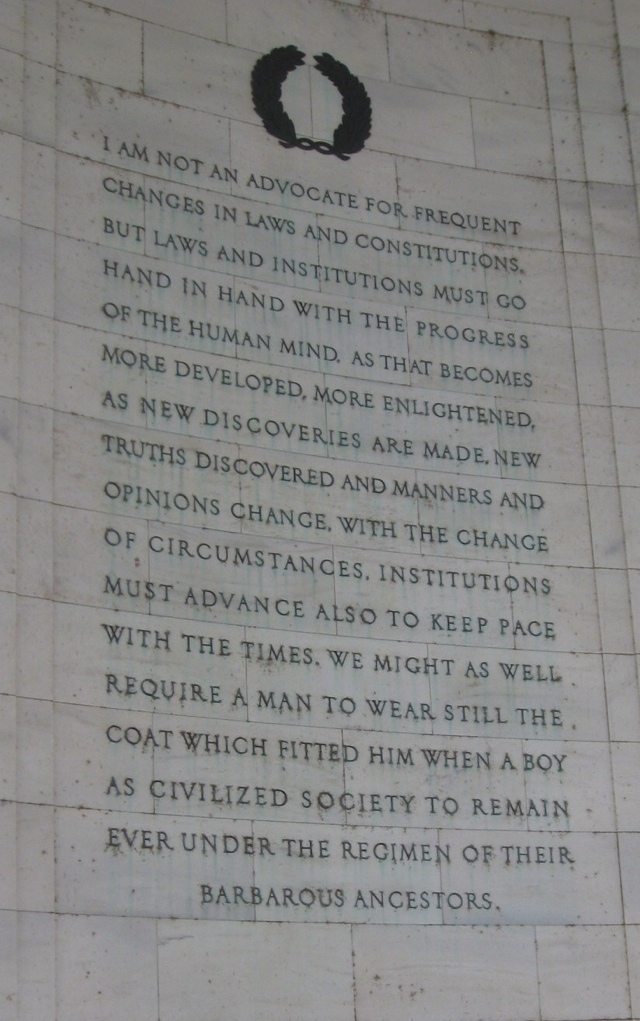
Talk of being the hapless products of our environment, of being the vassals of something bigger, of being the lucky recipients of the fruits of external systems, are all abdications of our responsibility; albeit a responsibility we wondered into unintentionally. We cannot get out of our way and everything will be alright, we have surpassed the point of no return on the evolutionary path and now we have no choice but to take up the mantle and grow into our role. I’m not sure there ever was one, but now there is no such thing as a self-directed free market that will serve our needs; our needs can only be met through intentionally directed activity. We cannot be slaves to a constitution written two hundred years ago and founded in traditions even older than that; we must accept the responsibility to develop a constitutional framework that suits our times and the nature of our modern predicament. Much of the nonsense spouted in the name of politics today is mere cowardice and ignorance in the face of an inescapable need to face up to the reality that humankind is now a partner in evolution, and not just a product of it.

Abdication in the face of necessity is not a strategy, it is pure childish folly. If you’re young enough to be pretty sure of being alive in 2030 you’d be a fool to let the mirage of ancient fallacies deter you from action any longer. And if you’re old enough to be pretty sure that you won’t be alive in 2030 you’ll go down in history as the most selfish and ignorant generation of the entire human race, if you don’t come alive to your responsibilities now and stop hiding behind the skirts of dysfunctional democracy and the hollow promises of dysfunctional economics. You are the determinant of the nature of your society and your society is the determinant of the output of your laws and your economy – take up the mantle, wake up your heart and grasp the nettle that is our common responsibility to intend our future, not accept an impoverished alternative.

The Minimum Wage is History

At it’s heart the concept of the Minimum Wage accepts the subservience of the social order to the economic order, and attempts to extract a concession from the economic system to maintain the fabric of the social system.

What’s the point of having a Minimum Wage? If the idea is to ensure that an individual’s work effort is not exploited so much that they cannot afford to sustain a basic, minimum lifestyle at that pay level, has it worked? No. Why not? Because it is a basically flawed remedy for a social problem imposed on an economic construct. It doesn’t work, it won’t work, and, in fact, it is polluting our political process by encouraging economic interests to subvert our political systems in order to restrain the impact of Minimum Wage legislation on their operations. (James K. Galbraith, Attack on the Middle Class, Mother Jones, Nov/Dec 2010)

In order for the idea of a Minimum Wage to achieve it’s stated objectives, two preconditions have to exist: people must have employment, and the Minimum Wage must be sufficient to sustain life. But in a capitalist society the availability of employment rises and falls with the business cycle of capital-intensive enterprise, so a Minimum Wage does nothing to help the worst off: the UNemployed. And in today’s capital-democracies the political process is subservient to the capitalist process, meaning that the level at which the Minimum Wage is set is subject to the approval of the largest capital interests (who control the politics).

At it’s heart the concept of the Minimum Wage accepts the subservience of the social order to the economic order, and attempts to extract a concession from the economic system to maintain the fabric of the social system. This ‘world view’ is a legacy of the awe with which we witnessed the incredible rise of capitalist enterprise in the 20th C. The basic flaw in that model is the notion that the economic system is sufficient to sustain the social system, it isn’t and won’t ever be – the economy is a subset of society and to no amount of imagination can subvert that reality. This is part of the structural problem at the root of our perilous rush to oblivion, the economy is dependent on the society, not the other way around. It is only when our social support systems are assumptively included in a picture of our society that it appears to the casual observer that the economy is our master. Belief in the ascendency of markets and capitalist economics is akin to belief in creationism, it requires ignorance of the facts. The facts are that our economy is 100% and inextricably dependent on our the health of our society.

On the other hand, no economist locked in a room with only economic theory could construct an argument in support of the Minimum Wage, it is a basically distorting mechanism that meets no economic goals. And that’s the point, the Minimum Wage is a social construct designed to try and deliver a social end. It’s time we stopped trying, and starting actually delivering the end we mean to. If we believe that a citizen is entitled to a basic minimum lifestyle (and we had better believe that if we value a peaceful, sustainable society), then we need to start delivering that, instead of playing with market mechanisms in an attempt to deliver the same. To quote Morpheous, “Stop trying to hit me, and hit me!”

If we carry on with our current approach, we are just floundering around in a nebulous construct that we know, deep down, is completely flawed at its foundation. It’s time to stop playing cricket on a football pitch and move the game to its home turf. Face it, live up to it, call it out and be proud: “We believe that every single person in our society is entitled to the basic services that sustain life. We’re not asking for permission to deliver on that promise, we’re going to deliver on that promise first and sort the rest out on top of that.” That we is you and me, we aren’t asking business to sort it out for us, we are taking responsibility for sorting it out ourselves. We’ll pay for it exclusively out of our income taxes and we’ll get it done without a single dime in corporate taxes, without a mandated wage and without the involuntary participation of any commercial enterprise. It’s our society, we live in it and we take full responsibility for it.

The minimum wage is history, it’s time for the return of sanity, responsibility and honesty. The minimum wage is an excuse for inaction, an innocent but ignorant attempt to pass our buck to people who can’t and won’t do what we say we mean to do. There’s plenty of income tax to do the job, we just need to do it, and for the sake of preserving a thousand years of civilization, we need to start doing it now!