Love, religion and politics

The common theme in all religions of stature is that loving kindness is the true path to happiness for humankind.

Practicing loving kindness needs development and training in humans, and so all religions incorporate guidance to their adherents as to how to accomplish the discipline necessary to develop an enduring practice of loving kindness. To promulgate these behaviors there is an obvious progression, especially in societies dominated by a single religion, to incorporating that guidance into the rules and laws of that society.

The root problem with legislating the path to loving kindness is that it is an internal journey, accomplished by individual humans for themselves, and cannot be externally imposed. So the whole endeavor becomes a completely self-defeating strategy as the freedoms of the humans subjugated thusly are curtailed and replaced with intimidation and oppression – the opposite of loving kindness! Spiritual traditions can offer a path to happiness but they cannot force anyone down that path; faced with this reality religious governments invariably conclude that their only option for non-conforming people is to imprison, main or kill them, otherwise they lose the credibility of their attempt to legislate their path.

Compounding the error, spiritual “laws” do not provide good guidance on the practicalities of running a developed society with millions of citizens. Inevitably, religious societies bring in the services of commercial minds to accomplish those tasks. Thus is born the moralist-capitalist state, of which there are many examples today, not least of which include Iran, China and the USA. This is doubly ineffectual because the commercial interest is not the same as the social interest, and now you have moralists restraining freedom at the same time as you have commercialists restraining the growth of wealth (the commercial mind is concerned primarily with the concentration of wealth).

For humans to develop their innate faculties for loving kindness they must live in a free society that is run for the benefit of its citizens. If we are to give ourselves the government we deserve, we MUST take PERSONAL responsibility for our own path to loving kindness. This insight is incorporated in the Standards of LIFE, and determines the absolute requirement for secular government.

Secularism

No choice.

The Logic Train

This needs to be addressed head on and straight forwardly. There’s way too much strife all over the world caused by the misunderstanding of this one issue.
Continue reading “Secularism”

Social supremacy

The ascendancy of society in a post-evolutionary age.

Nowadays we like to talk about the supremacy of our constitution and the ascendancy of market forces. We like to think of ourselves as living under the rule of law and we tend to think of our good lives, or our bad lives, being the output of our economies. After all, the muscular development of our economies has brought us the fruits of development and our societies are held together by the rule of law, right? Well, true, up to a certain extent. But we are in danger of missing a crucial truth that underlies these facts: law and wealth have existed before.

Great wealth and strong legal systems have been features of human empires before now: Egyptian, Mayan, Roman, Mongol, Ottoman, Russian and British empires, to name but a few, all had strong legal systems and generated enormous wealth. The difference between what exists today and the history is not the mere existence of law and wealth, it is the manner and tone of their application. This is the first hint at what we might be missing in our perspective of the current times. The fact that we have laws and wealth is not the defining character of our times, it is the nature of our laws and our wealth that distinguishes us from our forebears.

What determines the nature and manner in which law is applied, or economic wealth is experienced? It is the culture and norms of the society within which they operate that shapes the form and function of law and wealth. To think of the value of our society as the crude existence of the rule of law and the freedom of markets is to miss a crucial element; the application of our rules of law and the operation of our free markets are critically dependent on our social standards to deliver the preferred outcomes. Our society is not shaped by law and wealth, our society shapes our law and wealth. If you are thinking some version of “Well duh! Of course!” at this moment, then dodge this: you are not the recipient of the benefits of this system, nor are you the victim of it, you are a critically important shaper, protector and developer of this system. The supreme determinant of the quality of our system is not our laws and economies, it is the social framework within which those operate; and we are all individually and collectively responsible for the nature of that framework.

Understanding the supremacy of our social constructs as the defining framework that determines the quality of the outputs from our other mechanisms is a crucial step toward delivering better outcomes. Only once we accept responsibility for our role in determining the nature and norms of our society can we expect our laws and our economy to deliver the outputs we seek. Our laws and our wealth cannot protect us from that which we fail to take responsibility for, they are dependent for their efficacy on us first.

So it is the nature and the character of the society within which we define our laws and economies that determines the results. We cannot expect that our laws will defend us from the flaws we establish in our basic social constructs. Laws against profiteering will not prevent profiteering in the delivery of services that we outsource to profiteers. Laws against the trade in substances that we desire will not prevent the trade in those substances. Laws against unequal treatment will not create equality. Only when we have taken responsibility for establishing our standards will the mechanisms deliver results – intention is everything.

A crucial understanding that evolves is that we are not a society made from laws and economics, we are an intentional society that creates laws and economies to serve our society. A constitution does not define our society, it reflects our society. Free markets do not create our society, they serve our society.

The challenge that this presents us is that of being responsible for shaping our society, our environment, our framework. As creatures evolved from millennia of being passive recipients of our environment, we are not yet used to having to take responsibility for creating it, we are more used to seeing ourselves as actors subservient to the scriptwriter. But humans are no longer the passive recipients of evolutionary constraints, we have become active participants in defining our evolution. This presents an huge increase in our responsibility, and one which we tend to neither accept nor enjoy; but fact is truth and we have no escape from this development.

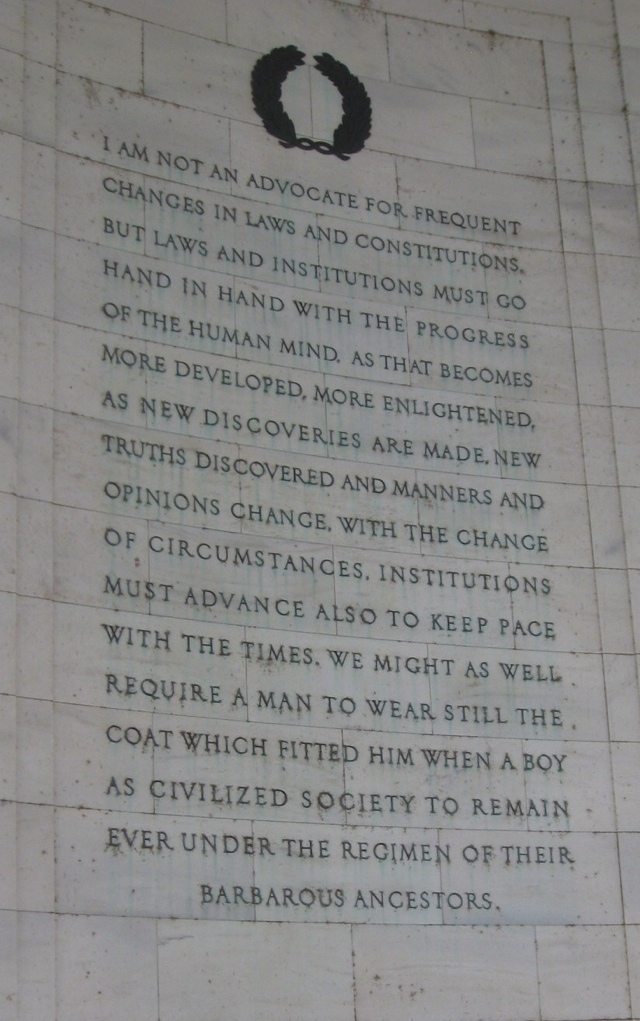
Talk of being the hapless products of our environment, of being the vassals of something bigger, of being the lucky recipients of the fruits of external systems, are all abdications of our responsibility; albeit a responsibility we wondered into unintentionally. We cannot get out of our way and everything will be alright, we have surpassed the point of no return on the evolutionary path and now we have no choice but to take up the mantle and grow into our role. I’m not sure there ever was one, but now there is no such thing as a self-directed free market that will serve our needs; our needs can only be met through intentionally directed activity. We cannot be slaves to a constitution written two hundred years ago and founded in traditions even older than that; we must accept the responsibility to develop a constitutional framework that suits our times and the nature of our modern predicament. Much of the nonsense spouted in the name of politics today is mere cowardice and ignorance in the face of an inescapable need to face up to the reality that humankind is now a partner in evolution, and not just a product of it.

Abdication in the face of necessity is not a strategy, it is pure childish folly. If you’re young enough to be pretty sure of being alive in 2030 you’d be a fool to let the mirage of ancient fallacies deter you from action any longer. And if you’re old enough to be pretty sure that you won’t be alive in 2030 you’ll go down in history as the most selfish and ignorant generation of the entire human race, if you don’t come alive to your responsibilities now and stop hiding behind the skirts of dysfunctional democracy and the hollow promises of dysfunctional economics. You are the determinant of the nature of your society and your society is the determinant of the output of your laws and your economy – take up the mantle, wake up your heart and grasp the nettle that is our common responsibility to intend our future, not accept an impoverished alternative.

The Minimum Wage is History

At it’s heart the concept of the Minimum Wage accepts the subservience of the social order to the economic order, and attempts to extract a concession from the economic system to maintain the fabric of the social system.

What’s the point of having a Minimum Wage? If the idea is to ensure that an individual’s work effort is not exploited so much that they cannot afford to sustain a basic, minimum lifestyle at that pay level, has it worked? No. Why not? Because it is a basically flawed remedy for a social problem imposed on an economic construct. It doesn’t work, it won’t work, and, in fact, it is polluting our political process by encouraging economic interests to subvert our political systems in order to restrain the impact of Minimum Wage legislation on their operations. (James K. Galbraith, Attack on the Middle Class, Mother Jones, Nov/Dec 2010)

In order for the idea of a Minimum Wage to achieve it’s stated objectives, two preconditions have to exist: people must have employment, and the Minimum Wage must be sufficient to sustain life. But in a capitalist society the availability of employment rises and falls with the business cycle of capital-intensive enterprise, so a Minimum Wage does nothing to help the worst off: the UNemployed. And in today’s capital-democracies the political process is subservient to the capitalist process, meaning that the level at which the Minimum Wage is set is subject to the approval of the largest capital interests (who control the politics).

At it’s heart the concept of the Minimum Wage accepts the subservience of the social order to the economic order, and attempts to extract a concession from the economic system to maintain the fabric of the social system. This ‘world view’ is a legacy of the awe with which we witnessed the incredible rise of capitalist enterprise in the 20th C. The basic flaw in that model is the notion that the economic system is sufficient to sustain the social system, it isn’t and won’t ever be – the economy is a subset of society and to no amount of imagination can subvert that reality. This is part of the structural problem at the root of our perilous rush to oblivion, the economy is dependent on the society, not the other way around. It is only when our social support systems are assumptively included in a picture of our society that it appears to the casual observer that the economy is our master. Belief in the ascendency of markets and capitalist economics is akin to belief in creationism, it requires ignorance of the facts. The facts are that our economy is 100% and inextricably dependent on our the health of our society.

On the other hand, no economist locked in a room with only economic theory could construct an argument in support of the Minimum Wage, it is a basically distorting mechanism that meets no economic goals. And that’s the point, the Minimum Wage is a social construct designed to try and deliver a social end. It’s time we stopped trying, and starting actually delivering the end we mean to. If we believe that a citizen is entitled to a basic minimum lifestyle (and we had better believe that if we value a peaceful, sustainable society), then we need to start delivering that, instead of playing with market mechanisms in an attempt to deliver the same. To quote Morpheous, “Stop trying to hit me, and hit me!”

If we carry on with our current approach, we are just floundering around in a nebulous construct that we know, deep down, is completely flawed at its foundation. It’s time to stop playing cricket on a football pitch and move the game to its home turf. Face it, live up to it, call it out and be proud: “We believe that every single person in our society is entitled to the basic services that sustain life. We’re not asking for permission to deliver on that promise, we’re going to deliver on that promise first and sort the rest out on top of that.” That we is you and me, we aren’t asking business to sort it out for us, we are taking responsibility for sorting it out ourselves. We’ll pay for it exclusively out of our income taxes and we’ll get it done without a single dime in corporate taxes, without a mandated wage and without the involuntary participation of any commercial enterprise. It’s our society, we live in it and we take full responsibility for it.

The minimum wage is history, it’s time for the return of sanity, responsibility and honesty. The minimum wage is an excuse for inaction, an innocent but ignorant attempt to pass our buck to people who can’t and won’t do what we say we mean to do. There’s plenty of income tax to do the job, we just need to do it, and for the sake of preserving a thousand years of civilization, we need to start doing it now!

Next Left

“It is clear that centre-left thinking is in need of radical reappraisal”, to quote from an Institute for Public Policy Research (ippr) paper entitled “Where Next?“, and which I recommend you read. The paper, subtitled “The challenge for centre-left politics”, is the outcome of a series of events on the subject and includes a summary by Tony Wright, Professor of Government and Public Policy at University College London.

The reality is that centre-left politics has been in dire need of new thinking since the 1970s when the oil shock put paid to the illusion of the imperial-welfare-social-democracy that was born out of post War social ambitions in those nations that were still riding on the subsidies of colonial pasts. When the resource origin nations suddenly demanded their price for their resource the industrial-welfare states had to reconfigure their economies to survive; and thence was born the modern capitalist-democracy in which the welfare of all was dependent on the abilities of their capital-finance agents to revive the same imperial exploitation, but this time in the name of capital instead of their Capitals.

What about the nascent rise of neo-socialist governments in South America, is that the next left? Unfortunately, while heartening in their self-determination, these examples are based on the same flawed socio-economic thinking that has just crashed neo-socialist governments in the old industrial world: a faustian bargain with the “masters of the universe” to bring the riches of resource exploitation and financial alchemy home to support their political ambitions. Not only do the New World resource-socialists risk being taken for a ride by the master manipulators, they also face the certain arrival of curbs on the very resources they hope to exploit, as the realities of atmospheric balance (to which they are most susceptible) start to bite.

It is clear that center-left thinking is in urgent need of radical reshaping, not only in the old industrialized nations but also in the New World and in the two great land powers without whose cooperation any such reshaping will be meaningless: China and Russia. A task indeed! But let’s follow the points raised by the ippr paper to see if we can’t see a way through to what’s next. At the core of the questions raised in the ippr paper is a reboot of the relationship between citizen and state in which the power that people have over their own lives is enhanced so that they can access the means of civilization for themselves, while the statecraft of government is reformed to provide core public functions and underwrite the results with its guarantee. This recognition of the legitimacy of the individual, along with the role of active government to deliver what individuals cannot, is the ground on which the centre-left must stake it’s camp. It is a citizen/service orientation, distinct from the worker/capital or market/government orientations of yesteryear.

A fundamental point raised in the paper is that now is precisely the right time to promote politics, in the face of widespread civic disengagement, as the means by which citizens confront common problems without recourse to violence. To do this effectively and credibly we will have to be open to institutional reform and even some constitutional reform. Enhancing our democracies to enhance the citizen-government relationship requires us to develop and implement better systems of representation, greater localism and a more transparent connection between voter and voted. The difficulties of delivering effective democratic control over the necessarily different levels required for differing purposes is a challenge that has not yet been met. The Next Left must come to bat with proposals, and open minds, to resolve the local through supra-national influence expectations of citizens. A system of multi-layer democracy that incorporates the principle of subsidiarity is the goal, and it can be developed by extending and enhancing what we have today, but not without some reform of our constitutional structures. We have to be prepared to bring this reality with us, develop solutions based on values and be willing to explain ourselves. When we know that local decisions are not well made in national assemblies and that national decisions cannot be made locally, we must embrace those facts in the adoption of a multi-layer structure that seats political power at the level appropriate for decision making. Citizens are not afraid of voting and they would rather vote for multiple assemblies than be disconnected from their right to influence. And when we know that a single transferrable vote in a multi-member constituency is the fairest way to vote, we must have the courage to lead with that as our banner for representation.

A new economic model is also vital. Governments need markets and markets need governments, that debate is done – what still remains is to establish is the basis for our future economy. We now understand that capital exists in relation to environment, regulation, people, society and unprofitable but vital needs: the new capitalism is a component of the total picture, not its foundation. In the Next Left the foundation of society, embodied in the vital service requirements of the people, is the responsibility of the people themselves and forms a foundation on which capitalism operates as a client system. Tackling the “poverty trap” and “incentive” problems inherent in the old welfare models remains critical because there must still be an infrastructure of support services in place that protect against insecurity and expand opportunity. The model that works here is that of Universal Services, whereby the cash-based welfare state is replaced by the delivery of the services themselves at the most local level, financed by taxes collected at the highest level.

Everyone has a stake in Universal Services and they fulfill the promise that links every citizen with the reason for having a state. But equally important is the effect that Universal Services have on the economy, on the ability of every person to participate and contribute to the society as a valid and valuable economic entity. It is at the local level that this effect is most pronounced as microeconomic activity is unleashed, complementing our capital-intensive industries. The economy becomes a client of the society and in so doing it develops a broader, more sustainable and less growth dependent nature. The guaranteed service levels implicit in Universal Services provide real accountability for local government, while directly linking citizens with the obligation to define priorities and accept that doing more of one thing will often mean doing less of something else.

So a framework emerges which combines the enhancement of democracy with a multi-level structure, the replacement of welfare with universal services and the placement of economic activity within the context of the society, not the other way around. This Next Left is grounded in principles and based on standards that provide a coherent narrative, placing the standard of life above the standard of living.

The Next Left must lose its predecessor’s reticence to tell its story, and paint a clear picture of a society that has intentionally moved beyond the democratic-capitalist model, that unashamedly takes responsibility for delivering the core public functions it is best placed to do, and which embraces the natural enterprise of the human spirit.

It’s time to stop asking what’s next, and to start answering that question. The Next Left is what’s next, and we’re all the ones who’ll do it.

Fundamental Rethinking Required

Why we won’t make it out of all of this without more fundamental rethinking.

If we think our economies, and particularly our government budgets, are in trouble now, just wait until we wake up to the true costs coming our way in the next decade or two. Balancing our budgets, using our existing system of economics, is about to go from difficult to impossible.

If the only problem the developed economies had to worry about was repaying their massive debts after correcting their budget deficits during a recession, then one could argue that a way forward can be found. However the challenge we face is greater, and we are going to have to fundamentally reform our thinking before we can turn our economics around.

There are clues to why our situation is more complicated in three factors that underlie our already obvious economic dilemmas: infrastructure underinvestment, social support bankruptcy and global resource constraints.

Infrastructure underinvestment
Even without providing for investment in climate mitigation, the WEF estimates that we are running more than a $2 trillion annual deficit in infrastructure investments and replacement. It is likely that the USA, India and China will need to spend $2 trillion a year on infrastructure by themselves, the unfunded deficit across the globe is probably around 2 to 3 times that number.

Social support bankruptcy
Never mind that we aren’t meeting the basic sustenance needs of millions of children every year in the developed countries, the global targets that the UN set itself for “Millennium Goals” are being missed at every turn. On top of all the social support we are failing to provide and haven’t accounted for, we have a massive overhang of known social support costs that we have accounting for. The unfunded pension obligations of developed nations are over $100 trillion and those pension shortfalls will start to materialize in less than 10 years from now – half a dozen states in the USA will have bankrupt pension schemes by 2020, and that’s before the US federal system runs out of money between 2030 and 2040. The published deficits in existing social security systems and pension schemes are not a complete picture of the gap in funding for social security worldwide – that’s probably 10 to 20 times as large again.

Global resource constraints
The third leg of this upside down stool is the inevitable rise in the cost of resources as the supply of raw materials becomes constrained due to increased demand and higher production costs. This will add another $2 trillion or so to the burden of the global economy every year for at least the next 30 years, probably more likely it will be 50 to 100 years. A $65 increase in the price of oil (putting it back at 2008 prices) would add $2 trillion a year to the cost base of the global economy all by itself.

Just fixing the current budget and debt problems of developed nations will mean correcting an annual $3 trillion imbalance, and then attempting to pay back $30 trillion of debt over 30 years. Assuming costs remain stagnant and growth could be accelerated to 3% plus, these seemingly enormous problems could be coped with. But when you add $6 trillion or more of annual cost on top of these numbers, the global economy would have to achieve never before seen (and completely unsustainable) rates of economic growth to make the numbers work out. It just ain’t going to happen–something’s got to give.

What could “give” to correct this impending imbalance of economic mathematics? One or more of the following will have to give: peace and freedom, the global economy and “sound” money or our current, traditional perspective. Indeed, all of these will have to give if we don’t rearrange our relationship between society and economy. Without a reorientation of perspective we can only have one of the first two, and even then only for a short time.

As we think about and plan our societies, we have to carry this understanding with us: if we try and pay for all of our welfare and social services with money, we are trying to satisfy the non-wealth portion of our society with our wealth. Not only isn’t there enough wealth to perform this feat, we’re actually abusing the role of money in our society. It’s like trying to make water out of milk… it’s possible, but you’ll run out of milk before you have watered the cow.

We have become blinded by the amazing rise of the capitalist economy, and in so doing we have dropped the notion of “in-kind” exchange from our thinking and our imaginations; even though we know intellectually and emotionally that “the best things in life are free”. In the real world, the in-kind transfer of social support is a necessary and vital complement to the capital economy.

What we are missing is the very nature and meaning of money. Money is a means of representing wealth. Wealth is material value accumulated greater than material need. You would not hesitate for a moment to profess that the total real value of your life, your family and your community is greater than the sum of your money, and therein lies the truth about why our attempts to value everything in money is doomed to fail the basic test of mathematics. The total value of every society is greater than its total wealth, and any attempt to contain its value within its wealth will wreck on the rocks of reason, sanity and economics. And yet this is what we are trying to do when we provide money in lieu of the social support we intend to supply.

The “traditional” perspective, although it is actually very modern, is that everything has to be valued in currency. The shift we have to make is to revert to a more fundamental understanding that currency is a method of transferring wealth is part of an economic transaction, and not every transaction needs to be, or should be, valued in currency. There are quite obviously enough people to provide all of the required social support services, to build the bridges and to modify our infrastructures for sustainability; it’s just that we can’t afford to pay everyone to do all of these things. Why should we pay each other, in currency, to do these things? Are these activities wealth creating?

The reason we are running out of money is because we, rightly, understand and practice the science of preserving the wealth symbolized by our money, otherwise we’d just print all the money we needed to pay for everything. But we cannot maintain the value of money and at the same time value everything with money, money can only be a symbol of wealth. That portion of human activity that is not wealth creating cannot be paid for with wealth and still preserve the value of money. I do not feed myself with wealth, wealth is what I have left after I have fed myself. The fundamentally distorting spell we have all fallen under is that our society will fit inside our economy. We are so used to using money every day to pay for everything we buy, that we forget to notice all the things we do for others, and receive from others, every day without pay. Our society is bigger than our economy and believing that we can pay for society out of the proceeds of the economy is borderline insanity.

Before we get too heavy, let’s recognize that there is plenty that we should value with money, everything that represents a transfer of wealth, and that’s many things. But there’s a large portion of society that we must learn to value differently, almost like a separate, parallel currency, only without numerical denomination. That portion of society that is what we must have before we can consider ourselves to have wealth, must be paid for in kind, otherwise we will destroy our wealth. The basic necessities of life, without which wealth is meaningless, must be removed from the accounting system we call our economy. The way to do this is to establish a system of universal services that satisfy the most basic universal needs we all have, and without which we cannot consider ourselves to have wealth. When we provide these for ourselves and each other without payment, we integrate the cost of our social needs into our lives, liberate money for its intended purpose and can actually build functioning, sustainable economies that can balance their money books.

Eventually we will have to change our perspective, it’s our choice as to whether we decide to do it now or later. The longer we wait, the greater the pain; but I suspect we haven’t felt quite enough pain yet to entertain such a change in thinking. After all, letting go of our attachment to a concept that we believe makes the world understandable, is one of the hardest things to do. But once we do, the world will make infinitely more sense.

Our Story

A proposal for a new, progressive, common narrative.

In response to Amitai Etzioni’s call in action in The Nation magazine for progressives to find a common narrative that tells the story behind our intentions, we offer the following as a starting point.

~ ~ ~ ~ ~ ~~ ~ ~~ ~ ~~ ~ ~~ ~ ~~ ~ ~~ ~ ~~ ~

The combination of science and enterprise over the last century has created a potent force for good, but which has lost its context within human society.

This has resulted in an unbalanced relationship, a disintegrated society, in which the engine of growth has become disconnected from the passenger cabin that it is supposed to transport.

Reintegrating our economy with our society will allow us to improve our standard of life and balance our relationships with each other and the planet we live on.

An Analogy
The engine belongs in the body of the car, controlled by the pedals at the drivers’ feet and steered by the wheel in their hands. The car cannot move forward without the engine, so the driver and the passengers must take care of the engine, ensure it has fuel and vital lubricants, as well undertaking any necessary maintenance to keep it running smoothly, cleanly and efficiently. The passengers decide who amongst them will drive and steer, and the drivers have responsibility for keeping the passengers free of unnecessary dangers.

~ ~ ~ ~ ~ ~~ ~ ~~ ~ ~~ ~ ~~ ~ ~~ ~ ~~ ~ ~~ ~

Through the fusion of science and enterprise, we have created the most powerful force in the history of the planet: the force of business and commercial enterprise. This force has the power to destroy the planet and human society, to obliterate species and make vast swathes of the planet uninhabitable for humans and others. The same force has the power to deliver a higher standard of life for every human, an achievement not even conceived of as possible a century ago.
At this time the pros and cons are pretty much equal. The damage done thus far has been in proportion to the benefits delivered; but to reap greater benefits using the current construct, we would have to damage our societies and our planet even further, and that ways lies self-destruction.
To bring the force of enterprise into service we have to reorientate our relationship with it, so that we care for it and nurture it in harmony and in balance with ourselves, and the pursuit of a decent standard of life for all on this planet. Unifying our individual liberty, our collective societies, our knowledge of science and our entrepreneurial drive will allow us to reap the rewards of life on this beautiful planet.

~ ~ ~ ~ ~ ~~ ~ ~~ ~ ~~ ~ ~~ ~ ~~ ~ ~~ ~ ~~ ~ ~

Integrating the force of enterprise into our societies means respecting it for what it delivers by taking responsibility for our social needs independently. To do this we must deliver basic universal services, paid for exclusively out of income taxes – this removes the constraints of minimum wages and makes taxation of enterprise a discretionary activity. In so doing we liberate the tremendous force of micro economics and instantly “green” our economy.
In order to achieve this reorientation and integration we need to devolve power down through a fabric of communities, regions and states so that decisions can be taken at the most appropriate level, because delivering basic universal services requires local delivery systems, managed and staffed by local providers, and controlled by local democracy.

Whatever happened to the European social model?

“Can the debt and deficit laden European welfare states . . . rescue their public finances and reform their social market economies?” asks Timothy Garton-Ash in a column in the Guardian this week. Can any of the Western democracies work their way out of their sovereign debt while maintaining their social fabric? Including the U.S.!?

Even before the bank debt crisis was transferred to the public purse in 2008, gaping holes had started to open in the public accounts of every developed society that was unable to exploit fortuitously local natural resources. The full development of the “social market economy” had not actually been possible until the latter half of the 20th century, and then only the most industrialized societies were able to give it a try. And give it a try they did, without employing the same cold, hard analytical skills that they used to develop their burgeoning, ravenous and muscular economies.

The reality in those countries that did look like social market economies was that they had split into two internal realities. Cold, clear market economies on the one side and warm, fuzzy political fantasies on the other. So long as the political reality didn’t infringe on the operations of the market reality, each could live in their own space, peering occasionally with bemusement into the other reality. The deal centered around the political reality being able to sustain itself without imposing too great a burden on the market reality.
You could ask anyone on the market side and they’d tell you that the politicians weren’t living in reality, that their math skills stunk, and that that “it” would never work – but heck, so long as vast swathes of society were happy to be deluded, and those delusions didn’t interfere too much with the “natural” market forces that really made the world tick… who were they to try and correct the fallacies, right the wrongs or destroy the fantasy?
On the other side, in the political reality, everyone was agreed, with great frustration, that the inhabitants of the market reality were just one enlightenment short of recognizing the inevitable self-destruction inherent in a market economy model that failed to recognize that it was supposed to serve the needs of the political reality.

The disconnect was pretty universal and early in life most people picked or found themselves in one reality or the other, which then shaped and framed their worldview thence forward. The actual reality, the real shared universe, got little attention and virtually no recognition.
What allowed these two realities to persist for a century, and what has now virtually collapsed in 2010, was the subtly corrupted accounting on which the market economies were based, and which sustained the illusion of self-funding welfare societies.

At the beginning, the social welfare provided was very meagre and was available to only a few. For instance, pensions were only subsistence and only a few lived long enough to collect them. In the middle, the economies that supported (funded) the slightly better welfare programs of their age were unconsciously over-muscular, leveraging unbalanced trade, resource exploitation, uncosted environmental pollution and unfair competition to generate unnatural wealth (profits) that made the welfare states that relied on them look affordable. In fact, they weren’t.
The collapse of the Soviet communist system mid-way through this period just “proved” to everyone that asserting the political reality over the market reality was a road to doom. In actual fact it proved the necessity of allowing natural markets to operate and the fundamental role of freedom in human society, but it did not help to frame the proper and useful placement of market economies – it just proved that we need them.
The the later stages, as social welfare developed more fully and costs rose significantly, the market economies of the West started to run out of resources and face greater competition from the rest of the world. In response to those pressures a complex system of debt was used to replace real wealth. The political reality encouraged the markets to manufacture a debt delusion that was bound to crash when it ran out of bubbles to inflate. This happened in 2008 and the real reality, that the political reality is dependent on the market reality, came home to roost. The first response, the understandable reaction to the shock, was denial; and the remedy was to repair the debt damage in the market reality by transferring it to the political reality, by bailing out the banks.

Now we must face the fusion of our political and market realities, if we are to forge a path forward for cohesive human societies. We must face the reality that we cannot account for our social needs with the same mechanisms that are appropriate for our market economies. If we are to build sustainable market societies we must recognize the social rewards of social work alongside monetary rewards for market success. The reality is that the market economy is a smaller realm of activity than the social services realm, and the market economy simply cannot produce sufficient monetary wealth to pay for the the necessary social activity with money.
Transitioning to this fused reality is not hard, or far away. The future of the “social market economy” is the “market economy society“. A subtle but profound transition of emphasis accomplished by an equally subtle and profound change of our priorities. The market economy remains but the political reality is profoundly altered by accepting responsibility for itself and transitioning from dependent to independent.
The market economy society establishes a framework within which the market can operate without responsibility for society, because society has assumed responsibility for itself and the market operates within a space created and nurtured for it by the society. The mechanisms that create this reality are simple and universal as well as being accessible and immediately effective.
In a market economy society the monetary cost of labor is only its commercial value adding quotient. This is true because the society provides the basic services necessary to sustain a reasonable life (shelter, sustenance, transport, education, healthcare, information and the protection of the law) for free – the majority of the cost of these services is absorbed by the citizens of the society in return for the reward of living in a peaceful, free, market economy society.

This is the only desirable and feasible human society. The debt bubble has burst, the industrial growth train has run out track and steam and the elevation of social awareness is irreversible.
The looming “age of austerity” being offered up by the old disconnected realities is neither necessary nor acceptable, as we shall see. The measure of our skill as a product of Nature will be our ability to reimagein our actual reality, with clarity of practice and intention.

What could have been… UK 2010 election results

If the UK had the LIFE PR election system in place the results of last week’s voting would have mirrored the desires and intentions of the people better, created a more effective legislative body and produced stronger leadership.

Of course, the UK doesn’t even have PR let alone a LIFE PR system. This left the average citizen trying to cast a vote that covered so much ground and met so many needs that they are to be commended for having made any choice at all. Faced with trying to select an effective local representative, choose a national direction and say something to the world, all in one vote, was a mighty task indeed. In the end many voted to keep out what they didn’t want. Hardly a model of effective democracy.

In a LIFE election the citizens would be casting one vote for a representative to the UK parliament/State Assembly. They would be able to pick from the same list of candidates, irrespective of where they live in the UK, and they would be able to select an alternative/second choice should their first choice candidate fail to muster sufficient votes to meet the quota. This would free everyone to vote for whom they truly wanted to lead their country, instead of voting for someone they didn’t want, and who wasn’t going to lead their country anyway, just to keep out a representative of a party they disagreed with even more strongly.

The UK State Assembly would have a maximum of 62 seats available [population/1 million]. Just over 29 million people voted so the quota for election to a seat would have been slightly less than 500,000 votes. On the face of it that would mean that Greens, who only got 285,616 votes, would not have had a single seat – but who knows how many people across the nation might have voted for a Green candidate if they knew that their votes counted? The BNP would have got a seat even though they got none in the May election, and UKIP would have secured 2 seats.

However all of the numbers are a little suspect because there was so much tactical voting and so little opportunity for the average citizen to truly express their intentions through their vote. Given the chance to choose a candidate who truly represented their views, citizens would quite likely have picked a much broader array of representatives to head up to Westminster on their behalf. Furthermore, with a LIFE PR system everyone 16 and older would have had a vote and those caring for others would have had their charge’s vote too – enfranchising the young, the old and the disabled.

So using the voting record from a flawed election to extrapolate what would have happened with a more perfect system is fraught with difficulties and anomolies, nevertheless it is interesting to look at. If nothing else if shows that the LIFE PR system is fair, effective and representative.

We will be posting a calculator model at www.standardsoflife.com that you can use to figure out for yourself how an election near you would have turned out if you had a LIFE PR voting system – post your results and comments at Topic – Voting.

The Unified Theory of People in Action

How do you pay for a peaceful, socially secure and democratic society with a sustainable economy?

There is a blind spot at the center of modern social-economic thinking to which we are almost universally susceptible, and yet it can be quite easily observed to be false. This is an introduction to that conundrum.

We all want to live in peace, with a certain degree of prosperity. Most of us would like this to be at least inter-generationally sustainable. Our general principles of organization are also fairly commonly established, including the rule of law and the freedom to choose our governments by popular election. That’s a pretty good start, and we all pretty much share these principles.

Within this general context, we have two primary schools of thought, the Left and the Right. The Left tends to believe that the quality of any individual’s life is dependent on the quality of the life of their fellow citizens, and that that quality is achieved through a communal effort to support the basic infrastructures of society, such as public services and social security. The Right tends to believe that everyone is primarily responsible for themselves and the consequences of their actions, and that the prosperity of a society is substantially dependent on the freedom to pursue opportunity and engage in enterprise.

On these basic points each school is right. Left and Right are not in conflict as much as they think they are, they just emphasize different priorities. However at the nexus of their disagreements is a mutually held fallacy: that the “economy” can produce sufficient wealth to “pay” for the society they wish to live in. The reality, the elephant in the room holding a giant sledgehammer and standing next to the mirror that they use to sustain their mutual illusion, is that the economy does not, and cannot, produce enough wealth to pay for the society they want.

The Right believe that a comprehensive social benefit system will result in withering tax rates that will deflate the economy, and that borrowing to pay those benefits is not a viable alternative. They’re right. The Left understand that our modern social civilization depends for its peace and prosperity on a functioning social infrastructure and that poverty undermines the foundations on which we all stand. They’re right, too.

What they are both wrong about is the math. The economy, after all, is just a system of accounting that lubricates the actions of people. The wealth that can be counted in money is the value added output of commercial enterprise, it is not a measure of the total output required to enable and service the whole society.

In developed, democratic, peaceful and prosperous societies children take a long time and a lot of effort to raise and educate into functioning citizens and economic participants. During our lifetimes we need a range of services such as healthcare, transport and access to information in order to participate fully in our society, and we live for a long time passed our age of peak performance and output. In fact, in a modern society, only about one third of the population is gainfully employed in wealth creating (i.e. tax paying) activities — the rest are either young, old or disabled. Yet every citizen at every age is a consumer of, and dependent on, the services and infrastructure of the society, without correlation to their wealth creating capacity or activity at any particular stage.

The elephant in the room is this basic economic math: that we are all greater consumers of social resources than we are contributors of monetary taxes. We do not pay our parents to raise us, nor does anyone else, and nor could any society afford to pay every parent for their services, any more than any society can afford to pay everyone who cares for an elderly person. We understand this intuitively; we know that our families, our communities and our society are dependent on the unpaid contributions of many. We know that to attempt to pay everyone who helps out is a totally impractical idea.

There’s enough expense in simply building and maintaining the infrastructure of a modern society to consume most of any reasonable tax on wealth creation. The naked truth is that every society is completely dependent on the voluntary contributions of its members, in return for rewards that are not measured in monetary terms. What we call “the economy” is not the same as our society, and it only represents and accounts for a minority of all the people’s actions. The economy can never generate enough money to compensate everyone for all of their activities. No society can function without this volunteer action, and yet it is outside the system of accounting that we call our “economy”. Our society is a larger body of action than our economy, and you cannot pay for the larger out of the smaller.

And so the mirror is broken, the elephant having deployed its sledgehammer, shatters the illusions of both Left and Right. We cannot tax our way to equality any more than we can survive as a society without education, transport and healthcare. Yes: corruption, military spending and inefficiencies are terrible wastes of money, but the reality is that even if they all stopped tomorrow we still couldn’t afford to pay for all of the facilities of a functioning, prosperous, democratic society out of taxes on the demand economy. Even if our military spending would pay for universal healthcare, or quality education, or high-speed public transport — it won’t pay for all three. Modern social civilizations require a vast public infrastructure for transport, energy, information and public services, further amplified by climate mitigation needs. And if you don’t provide these facilities you can’t have peace, freedom and security to enjoy whatever prosperity you do have.

The mirages of self-funding, social democracies are often referenced, but do not withstand scrutiny. Those nationstates today that look or claim to be pulling off the trick of tax-funded, socially secure prosperity are taxing so highly that their economies are running below the necessary long-term capacity, unsustainably exploiting finite natural resources or effectively borrowing wealth from another society – all good while they last, but not sustainable. In a sustainable global economy trade must eventually be balanced and local economies substantially self-reliant.

Once the hammer has smashed the mirror, both Left and Right find themselves looking at the same dilemma: how do you fund, account for and maintain a social civilization with a sustainable economy? There are very substantial costs involved and taxes cannot generate sufficient revenues to pay for it all.

One answer is surprisingly simple, cheap and effective. It can be implemented immediately without requiring redistribution of assets and without overly disruptive changes to the basic mechanisms of administration, monetary control or enterprise. Once we accept our volunteer social membership status, the next steps fall easily onto the path in front of us.

The first step is to dedicate all income taxes exclusively to the provision of basic life-sustaining services for all citizens: basic shelters for the homeless, public canteens for the hungry, basic education, healthcare and public transport for all. You make all of these services available to any citizen, on demand at no charge.

Next, you remove any controls on the minimum compensation that anyone can pay or earn for work. Minimum wages are unnecessary because minimum life services are provided instead.

Third, you make income taxes universal and fixed to the cost of providing the services in the first step, and not to exceed a rate of 50%. This creates a cap on the maximum costs of providing the services, and defends the incentives that support a robust enterprise economy.

When implemented in today’s advanced societies and economies, these steps create positive feedback loops that result in full social development, an expansive and resilient economy with average taxation rates on income of around one third. The other activities of government can be funded using local, sales or corporate taxes.

No one gets any cash benefits, everyone is free to take responsibility for themselves and a flourishing economy supports the social fabric of democratic civilization. Not Left, not Right, just unified people in action.

(To see how this all works in more detail go to www.StandardsofLIFE.com)