Decision Density – Corruption Catalyst

The relationship between decision density and corruption provides the clue to reducing both.

Corruption is the pernicious rot that bedevils even the most “civilized” of our modern societies. At its worst it deprives millions of even the most basic dignity, but it always perverts the course of democratic will, our intentions, the peoples’ good. Far from being a compulsory attribute of life, corruption is the outcome of human tendencies that we can, indeed we must, intentionally construct our societies to minimize. After all, corruption is just another form of crime, and we do plenty to deter other criminal behaviour.

Corruption is the misappropriation of other peoples’ money, the perversion of standard processes and the manipulation of good intentions. Like all crime, it is dependent on two primary factors: the opportunity and the motive. Given that the motive is part of an internal process in the individuals who commit the crime (that’s the bit used to excuse it), structural solutions must focus on the opportunity (that’s the bit we can do something about). The opportunity for corruption stems from the confluence of two conditions:

  • the abstraction of the decision point from those affected,
  • a lack of oversight and transparency.

When decisions get condensed into a small group (such as Gaddafi’s family in Tripoli, the policy elite in Washington DC, the super-bankers in the City of London or NY) they become subject only to the oversight of others within that group. It is inevitable, even desirable, that some decisions affecting millions are taken centrally, but we should be cautious about any centralization of decision making on the understanding that this propensity for undersight exists. Oversight takes time and resources, and when decisions are clustered in a small group the likelihood that decision density will exceed oversight capacity is greatly increased.

A decision taken at a substantial distance from those affected is less likely to be questioned effectively. Even if the interested parties have the resources to review the decision, they cannot access the remote decision makers. And visa versa, if the decision maker is not subject to the effects of their decision, they inevitably care less about the impact.

LIFE MLR Model
LIFE MLR Model

Spreading decision making out to the lowest effective layer is the key to improving decision quality and reducing corruption. The absence of an integrated framework of distributed democratic power, that allows for the placement of decision making at the most effective level, is the most glaring hole in our current constructs for democracy; and we must remedy that if we are to make the progress we need to make on so many fronts. Those who are starting now to implement democratic systems for their societies should pay close attention to the critical importance of formally integrating distributed democracy, because just democratically electing a national president is likely to do very little to improve their condition.

Multi-layered representation is an important development for 21st century democracy, and it’s time we started to incorporate it into our thinking and our demands for our futures.

New Economics

Along with the newly emerging democracies of the world, a new economics is desperately needed. The current economic model is at the end of its road and that is readily apparent to many savvy observers.

There are two factors driving the need for a new economic model:

  1. The desperate need for social and physical infrastructure investment
  2. The crisis of monetary management

We can see a new economic model by reconnecting with the truth of our existence: individual humans, born in relationship and seeking purpose – in that order. Understanding that sequence and priority, we can place our economy in its appropriate context: our economy is a client of our society. In so doing we can shed the delusion of “total economic valuation” (in which everything has a price tag), and clearly see that there is much activity that is not, and cannot be, valued in monetary terms.

In the new economics, social value is not accounted for with money. Demonetizing social value immediately transforms our economics; it makes investments affordable, protects the value of money and creates sustainable social structures.

Investments

We need to make some massive investments. The demographics of the developed world demands social infrastructure to manage the changing ratios of contributors and dependents. The demographics of the developing world requires economic infrastructure to support the burgeoning youth population. And the demographics of the entire world requires physical infrastructure for transitioning to a sustainable energy supply.

Among the recognized investments that we all need to make are:

  • education – life long, civic and skills
  • energy – replacing stored & extracted with renewable & sustainable
  • transport – leveraging the new energy infrastructure
  • water, food and health
  • shelter and sanitation
  • information, democratic accountability and transparency
  • investment in research, innovation and development

These investments are not only large, they are essential! We have to find a way to make these investments, and no one in the current economic modus has got a clue, let alone a practical path to their accomplishment. The most significant reason why none of the current practitioners has advanced any concrete ideas is because they are mired in the current morass that is modern monetary policy.

Monetary Mess

The worldwide crises in monetary management of fiat currencies has exposed the fundamental flaw of attempting to visualize all human activity as economic activity: the debt burden is unreasonable and unsustainable. This is resulting in the need to bankrupt national societies just to try and maintain a delusion of currency rectitude.

The economists and economic policy makers of today are stuck between what seem to them to be unreconcilable problems:

  • massive public debt
  • unbalanced budgets
  • unaffordable social security systems
  • currency credibility issues
  • inflationary pressures
  • massive investment deficits

Central bankers across the world, in the vacuum created by political inaction, are trying to balance the credibility of their currencies and budgets with massive debts and the need for growth and investment. In a world where prosperity is seen as a gift to the people from the bounty of commercial enterprise, these problems cannot be resolved. But they can, if we just pause for a moment and observe the reality.

New Economics is the only option

Into this world of monetary and investment crises arrive the newly emerging democracies of North Africa and the Middle East. The need to replace decrepit, crony economies with sustainable economies is a parallel requirement of the arrival of freedom and dignity. The demands of the protests are overtly political, but they are subliminally economic as well. What do they see when they look around the existing economies for inspiration for their new world?

None of today’s dominant economic models are providing a sustainable path to a future for their current adherents, nor would they for any new arrivals. Read this collection of essays from some of the preeminent economic experts of the day, and you will see that no one has a solution to the debt v. investment conundrum we are facing. The Western capitalist models cannot balance their books without forever pushing their debts out to the next generation. The Eastern capitalist models are mired in inefficiencies, corruption and environmental degredation that do not deliver sustainability, while also being dependent on the suppression of freedom and dignity.  Neither of these offers a model worthy of adoption.

The new, sustainable economics seats the economy firmly within the context of society and generates growth out of untapped micro-economic capacity. The new economics provides the wellfair necessary to support aging populations, enables affordable infrastructure to create a new energy platform and delivers vibrant growth for coming generations.

New Economics is the result of a three step process that yields sustainable prosperity, affordable investment and sound monetary management:

  1. Understand the economy as a client of human society
  2. Take responsibility for society by delivering social value through Universal Services instead of welfare
  3. Unleash the total potential for growth using modern communications to enable micro-enterprise

To preserve the peace we have, and move forward to sustainable prosperity, we all have to take the first step. Ask yourself: “Am I a human being, or an economic asset, first and foremost?”. I think you will agree that you are a human first; and so it follows that your economic value and activity is a subset of your humanity. That too is the valid order and construction for human society. The economy is a subset of our humanity and it is an illogical and impossible task to try and value all human activity in monetary terms. When we assimilate this understanding and stop trying to “pay” for our social needs, we can liberate our economy to fill its natural role in the firmament of human existence.

The structure of New Economics is laid out at www.standardsoflife.org in full. The principles that reconcile the seemingly intractable problems of today’s economic systems are also discussed extensively in this blog – select the Economics category to see a full list of articles.

Option 2 : Everyone is right

We need to cut our debts down to size. We need to invest in our infrastructure. Taxes reduce incentives, and need to be held to a minimum. Without education and research we cannot build a peaceful and prosperous society. The political system is unresponsive and corrupt, and needs fundamental reform. The financial industry is overweight, and needs to be regulated. Without enterprise we cannot afford our lifestyles, so we must support and encourage businesses. There are bad people in the world, and we need to defend against them. There is oppression in the world, and we need to support the rights of the oppressed. We must balance our budgets. We need alternative energy sources. We are too selfish, ignorant and introverted. We are empathic, loving creatures who all share common ancestors and a common planet.

All of that is true.

And there are the truths we dare not speak aloud because no one has their answers:

  • Capitalist economics is fundamentally dependent on a social safety net for its survival.
  • Humans have never before inhabited this planet with today’s atmospheric configuration.
  • Human-scale is not an option, for humans it is the only option.

In the face of all these seemingly conflicting truths many of us are dazed and confused. How do you lower taxes and spend on infrastructure? How do you regulate banking and enable commercial enterprise? How do you survive in a world of differences without a massive army? How do we get from the mess we’re in, to sustainable prosperity? Confused?

Confusion is only a very short term option. When you are walking in tall grass and you hear a rustle, you have a moment to decide whether you will change direction or speed; after a short time you have made your decision, even if you have not acted. Confusion is not a valid state, it does not appear anywhere in Nature except in the human mind. Confusion is the nexus of choice and contemplation, and it exists within the unyielding contexts of time and consequence. It is the curse on the flip-side of the luxury of choice. We cannot remain confused in our thinking and about our options for long.

It’s time to stop taking sides and start deciding.

Option 2

The choices we face are simple:

  • Option 0 : There’s nothing wrong and nothing needs to change (Ignorance)
  • Option 1 : Things need to change, and I don’t know what to do, but I am ready to support someone else changing them (Confusion)
  • Option 2 : Things need to change and I am changing them now (Action)

Which option are you taking?

In order to take “Option 2” you have to move past describing all the things you know to be true, and decide what to do about them. Everything in the first paragraph of this article is true, there is no sense in splitting one set of truths from another. Identifying with one set of truths might provide you with identity, but it does not move us closer to resolution.

It’s time to start talking seriously about what we’re going to do differently, about what we are actually going to implement in the next few years. We need to engage with solutions: real, practical changes we are going to make in our social, political economic structures now that will actually lead to a sustainable existence.

That’s what we are doing at Standards of LIFE – and we need you to join in. Take Option 2!

Money Flows

Hot money flows will not save the bankrupt status quo.

This week two news stories pointed to an issue that, wish it were otherwise, demonstrate the need for fundamental system change. The first story regards the fortune amassed by the Mubarak family during their rule of Egypt and the second concerns the massive scale of the corruption afflicting Indian society. Read the comments after the Indian article to get a real grasp of how this kind of corruption affects the core of a society down to the smallest neighbourhood, and this story that reveals the extent of the theft of public property in Egypt.

Where do these trillions of ‘hot’ currency go? They go into banks in the Western industrialized nations and their lackey tax havens – these three components form a coherent whole, interdependent on each other. This is colonialism by corruption, and the citizens of the beneficiary societies are as guilty of complicity today as they were 100 years ago. If you live in the West, don’t feel bad about it: you’re as much a victim as the citizens of the new ‘colonies’, because the same institutionalized theft is robbing your neighbourhood of resources just as much, through tax avoidance.

Why is this tolerated? Well it’s not tolerated by those who can’t do anything about it, in Egypt and India; they are just in a state of powerless despair. It is tolerated by those of us who can do something about it, because we have been unwitting clients of the system. The availability and use of debt to finance our distracted acquiescence has been the magician’s move that has drawn our attention away from the true play that is being made. In this trick there is a fine balance that the magician must strike, wherein the audience feels like it is getting more than it deserves, without actually getting real benefits. Like any sidewalk hussler, when the opportunity comes along to really cream a willing punter, the escape requires all parties to feel sufficiently guilty that no one feels entitled to recompense. This where the citizenry of the West is: asleep at the table, engorged on the fake food served up by the chefs in the kitchen while they resell the real food out of the back door of the restaurant to their buddies on the black market.

What can be done about it? The complete reorganization of the banking system. Preferably a coordinated reorganization encompassing the US, the EU, the UK and Japan; but even a principled stand by one of those financial centers would put the cat amongst the pigeons enough to disrupt the system and lead to change over the medium term.

What are the consequences? Without the hot, secret money Western banks will not be able to generate the profits they do today, nor would they be able to support the same level of employment. The fall off in tax revenues and employment in the client states would have to be offset, requiring a fundamental reorganization of commercial and social infrastructure. The net effect on tax revenues to Western states might even be positive, as banks pay a smaller percentage of their profits in taxes than the individuals and corporations who use the banks to avoid tax would have to pay on their incomes if they were properly declared. Potential benefits to non-haven states would be massive improvements in social wellfair, but would only accrue if accompanied by a significant democratization of their political systems – that democratization would be much easier to achieve without banking system support for corruption.

When will this happen? When the balance of benefits to the citizens of the haven states falls below even. The citizens of those haven states have already assumed the burden of the 2008 bank bailouts, but they have accounted for that with debt, so the full reality of those costs have not yet been bourn. The “plan” is to meet those debts over the coming decade by leveraging the same financial colonialism and conjuring (the failures of which created the debts in the first place) so that the massive increase in the money supply (aka ‘printing money’) that was used to account for the debts can be matched to grown wealth. This plan relies on the perpetuation of the existing banking system, complete with inflows of hot, corrupt money from all over the world. This is why today’s Western leaders will connive, lie and obstruct as much as they think they need to to protect the status quo, because they do not know how to plan for or adjust to a fundamentally reorganized society – they are not evil, they are just clueless.

The troubles with the “plan” are already becoming obvious. First is that the wealth that is being created is being confined to very small slither of the populations of the haven states, and, in a superb irony, they are using the same financial corruption to avoid adding to the wealth of states they inhabit. Second is that the debts cannot be satisfied with the growth that is available, and must be supplemented by sucking more wealth out of compliant tax payers through ‘austerity measures’. Third, none of the first two plans is happening fast enough to stop the excess money causing inflation, further exacerbated by real increases in the costs of raw materials. These problems mean that the haven states will start, this year, to raise interest rates to combat inflation, and in so doing push the balance of benefits for their average citizen firmly into negative territory. 20% youth unemployment, rising basic living costs and a kleptocratic ruling elite are the perfect ingredients for a revolution – witness North Africa, January 2011.

In the next few years, as real social disruption develops in Western states, a serious debate will emerge around whether completely reorganizing our economic and social frameworks is actually any less disruptive that attempting to maintain the old status quo. If we desire a constructive process of change we need to start thinking now about how that reorganization can manifest positively – that’s the reason to read and contribute to alternative thinking like the Standards of LIFE.

Insight : Desire : Resistance : Momentum : Pressure : Change : Effort

The incredible events of January 2011 in North Africa and the Middle East show us the natural passage of real change. Change is not easy, it is not painless, and we all have a certain resistance to it. Whether it is in our personal lives or on the political and social sphere, we recognize the need for change long before we act to actually bring about that change.

The result of our natural resistance to change is that, when it does happen, it appears to happen quickly. It looks like there is a sudden turn around, a dramatic change of character that seems to precipitate out of nowhere. It does not come out of “no where”, it is just “now here”. Real change is preceded by many steps before the step we call the “change”. First there is insight into the condition that transforms unconscious acceptance into a conscious desire for something different. Then there is resistance as the conscious mind evaluates the consequences to everything else that will result from this change. There is natural caution and wariness that mitigates against disruption that might not justify the benefits of the change. If the value of the change is sufficient, the desire for it builds momentum internally against the bulwark of resistance and starts to build up pressure. Finally when the pressure is high enough, some random event appears to trigger a rapid progression of actions and awakenings. This is the moment we call “change”; in fact, this moment is the culmination of a process.

There are two important facets to this process that are best consciously recognized in advance for the change to be both lasting and as free of collateral damage as possible. First, that there is time to prepare; second, that after the change event there is still lot of work to do.

The change event is often so seemingly spontaneous and rapid that developments occur in quick succession, and there little, or no, time to develop processes or plans in the moment. This is the reason why it is “the ideas lying around at the time” that become the modus operandi immediately after the event. In our personal lives the change event often comes to us without an opportunity to consciously perceive its imminent arrival, and so we are necessarily at the mercy of the tools that we have immediately to hand at the time. But in political and social change there is usually a developing consciousness that affords some the opportunity of foresight, and they can prepare the ground in advance of the event by evaluating and developing the options and alternatives. This preparation, by those who can, is valuable and important work, performing a significant service to others and the greater good.

After the change event(s), the translation of insight and desire into a lasting and credibly different path forward requires real effort and focus. To a certain extent, the drivers that lead to change happen unconsciously and spontaneously, but a new reality must be forged consciously out of the present conditions. Prior preparation can help just by recognizing the amount of work that will need to be done after the event, and how long it will take. Change is for the best when it is backed by determination and effort – history is littered with the stories of post-revolutionary reversion.

All this is the reason for developing The Standards of LIFE. A recognition that significant pressure is building in societies across the world and that the coming decade will see resistance overcome in many places, in many hearts and in different conditions. We are working to develop alternative models for our societies, our freedom and our prosperity that will serve us well when we decide that the time is right for us to change our status quo. Join us! Start preparing for your change!

The Path to a Future: The Path

Part 2 in the serialization of the The Path to A Future. The Path of orderly change.

A new section will be posted every 2 weeks during 2011. Enjoy!
If you want to get a free PDF of the book go to http://www.standardsoflife.org/thepathtoafuture.

What makes now such an important time is that we have reached a crossroads. We are at a point where the only constraint on our destination is our choice of direction, our decision to limit our impact on our environment, this planet.

We have scaled the heights of growth and technology so effectively that, without a singular focus on living sustainably, we will change our planet’s environment very significantly, probably catastrophically. No matter where you live, or how rich you are, or how clever you are, you cannot be sure that you or your offspring will be amongst the survivors of climate change. Your best bet, by a long shot, is to choose orderly change over chaos. The Path is that orderly change.

The Path follows a simple logic that goes like this:

  • In order to bring about the global changes necessary to avoid catastrophic climate change we need peace. Without peace we will not be able to assemble or coordinate the resources and processes required to build The Path to a Future.
  • Even with peace, we still need everyone’s voluntary, personal and active participation in order to make the right choices, select the best leaders, develop the technologies, work together and implement the changes.
  • We’re not going to get global peace and cooperation unless there’s something in it for everyone. The Path to a Future cannot just be in people’s eventual interest; it must be the best thing for each and every one of us to do now.
  • Finally, The Path has to lead to a future that we want to live in. The future we aim for must be much better if we are collectively going to make the effort required to get there. This future must not only be sustainable, it must be much more fun, with more freedom and ample opportunities for joy for all.

The Path is made from three simple, reinforcing elements:

  • Peace is necessary to focus our resources on providing for our security.
  • Security allows prosperity to flourish.
  • Prosperity allows us to build greater security that sustains the peace, which makes broader prosperity possible.

These three things are inter-dependant. Not new and not rocket science, but with one big and important difference today: realistic achievability.

The link between peace and prosperity was expressed eloquently by Martin Luther King a generation ago (Beyond Vietnam, April 4 1967, New York), and the generation before that by Gandhi, and so forth back through the generations of time. What is different now is the global impact of our choices, and the possibility for global change. Before now to imagine globally coordinated or synchronized change was the stuff of dreams, but today the imagined differences and barriers between peoples have been brought low by the advent of global telecommunications.

The fear that others do not want the same results or that different cultures have irreconcilable differences has kept our sights low and our vision narrow. Now we can see on TV, with our own eyes, people in every corner of the world speak of the same desires, the same intentions and the same simple hopes for themselves, their communities and their planet. Mothers in Maharashtra, Manchester and Malawi all want exactly the same things for themselves and their families.

Keep this in mind as you wind your way down The Path with me. It really is possible for people everywhere to adopt the simple changes proposed in this book, and implement them where they live. In our time, in this age, these ideas can be discovered, disseminated and the process of change started. Within a decade change can be happening across the surface of the globe.

In this book I will attempt to show you that you can build this Path, that there are changes that you can make in the community, region and state that you live in today. I will try to be explicit about what the changes are, without ignoring the fact that exactly how they are achieved is going to be dependent on your specific situation.

After reading this book I hope that you will share with me:

  • A joy about the possibilities in front of us
  • An understanding of how the changes work together to create The Path
  • An enthusiasm for sharing The Path with others, based on your own intuitions and understanding of its value
  • A desire to start the changes where you live See you on The Path to our Future.

Continue reading “The Path to a Future: The Path”

We Know Better

Bottom up or top down, which way is best?

We know better than you. That’s the basic message we hear nowadays – from captains of industry, diplomats, politicians and humans with a claim on the mind of god. But the truth depends on where you’re standing and who’s saying it.

Are you a Monsanto executive talking about how to feed the world? Or are you a farmer talking about what works for your land?
Are you a Western diplomat talking about Middle East peace? Or are you a Middle East citizen talking about your community?
Are you a banker talking about sovereign debt? Or are you unemployed in a capitalist democracy?
Are you an executive responsible for 10,000 employees? Or are you one of those employees?
Are you a pontiff? Or a victim of rape?

Who knows better than you?

Well, you know that no one knows better than you, about you. It is an inevitable facet of being alive that we are the experts on our own experience. This leads us to develop a certain confidence about the veracity of our perspective that we bring unconsciously to our opinions about other things, things that are not actually our own, personal experience. This false confidence is why the useful development of our selves passes inevitably through humility. Humility is a process by which we learn to distinguish between we can really know, because it is our own experience, and what we are deducing, based on the combining of facts we have access to and our experience with similarities. Without an intentional effort to develop awareness and humility, we are mired in a thoughtscape of certitude that serves our perspective but does nothing for the common cause. In other words, no one need know better than you, so long as you are not making decisions for anyone else; if you are making decisions that affect others, it is supremely important that you understand who knows better than you.

So “who knows better” is defined by both access to facts and access to humility. Those with access to facts but without humility are subject to arrogance and self-deceit that depreciates the value and quality of their opinion. Today power is centered around a “top down” approach, whether that be in the form of major multi national corporations or the political elites of industrialized societies, that is substantially lacking in humility – as is demonstrably proven by the Wikileaks revelations. This need not be a bad thing, in and of itself, because many decisions made for the good of the majority are best made at a high level; but if humility is missing from the atmosphere that those decision are made in, the quality of those decisions becomes disastrously poor. And poor decisions made at the top, for vast constituencies, are potentially catastrophic for everyone – witness the quality of current decision making about climate change.

Successful leadership in a successful society brings together facts and humility, often in the position of a ‘public servant’: an acquirer of knowledge who acts on behalf of the greater citizenry to enable high quality, effective and empathic decision making. But even a public servant cannot be a knower of all things and there is bound to be tension between the goods of overlapping constituencies, and that is why we also have politicians. Politicians are supposed to take the informed knowledge and opinions of multiple public servants and fashion policy, meaning that they make the decisions arbitrating between competing ‘goods’. The entire decision making process in advanced and complex societies is substantially dependent on the quality of the public service that feeds information into the decision making process in the first place. That leads us to another very worrying development of the last few decades in many powerful democracies: the public service has, all too often, been co-opted by the private sector. Through a combination of devaluing the work of public servants and attempting to honour the unbridled right of every individual to seek the opportunities that reward them the most, we have corroded the boundaries between public and private service so much that there is now, in many countries, a revolving door between the two.

The best decisions would be taken by those informed by the best knowledge of the issue, steeped in humility and the pursuit of the greater good. Instead we have decisions taken by the supplicants of the rich and the powerful (privately funded politicians), informed by a public service that always has half an eye on the best interests of the private sector for whom they may wish to work in the near future. Humility is not even regarded as a quality worth having, and quite possibly it is seen as a weakness.

So who knows how to fix this?

It is helpful, and important, to recognize the multi-layered truth about decision making and the source of useful knowledge. It is unlikely that any one person is the exclusive holder of the truth, it is more likely that there are a few truths dependent on perspective, and that the best decisions will come from reconciling these to fashion a ‘best possible’ solution. The better version of decision making will incorporate this multi-layered reality in its foundation and structure, such that decisions are made at appropriately different layers for different issues. A decision making process that incorporates this reality will best serve the greater good in more cases than either a single top down or bottom up diktat. While today’s power structures are undoubtedly top heavily and need of radical adjustment, we would do well to consider this nature of the problem, and the best possible solutions before simply electing to turn the hat upside down again. (I say “again” because we have had revolutions before, inspired by a desire to turn the power structure upside down, but they quickly run aground on the rocks of practical realities, and revert to upside up in pretty short order.)

Thankfully, we are already fairly well equipped to make this transition because we have already adopted two important building blocks for better decision making: defining the multiple layers and establishing voting systems. Layers are geographically concentric segmentations of our lands; where continents contain countries, countries contain regions or states, and states contain counties or communities. All this is already practically implemented and established, albeit in need of a large dose of citizen choice in the form of self selection of association. Furthermore many places around the world already have voting systems set up in each of these constituencies, and many also have distinct layers of government at each level of constituency.

So what do we need to add or change?

Ironically, the biggest flaw in today’s democracies is that we have “bottom up” ways of electing politicians to our “top” layers of government. Inherited from our tribal, non-technological heritage we send local representatives up to regional, national and international decision making bodies; where they are quickly overwhelmed by the scope and size of the issues and the large interest groups formed specifically to operate successfully at that higher layer. The exception to this is the presidential model whereby an “executive” is voted for by all the members of the total constituency. However, keenly aware of the potential for corruption in an individual, we make that executive’s decision making power dependent on the support of the elected assembly of local politicians. This has been the “state of the art” structure for politics for over 200 years, and is often lauded for its incorporation of a “balance of power”, or system of “checks and balances”. In our modern world however, this structure is failing us, and fails to deliver the quality of decision making that we could have with a modernized structure that incorporates the advances in our technological capacities over the last two centuries. Modern communications and transport mean that now we can know about and vote for candidates over vast geographies – witness our existing presidential elections as an example of this in practice already.

Instead of a bottom up electoral system to generate top down government, a “layered” electoral structure, with a direct line between every citizen in that constituency and their representative for that layer of government, will yield better decision making by politicians specifically focussed on the issues best addressed at that layer of government. The citizens not only decide who makes decisions on their behalf, but also at which level or layer those decisions are best made. In a multi-layered democracy every citizen votes for a candidate from exactly the same slate of candidates as every other citizen in that same constituency. For instance, for a national assembly: every citizen in the nation votes for a candidate standing for election by all the citizens in the nation; the candidate is not going to the national assembly to represent a local district, they are going to the national assembly to make decisions about national affairs, and only national affairs. That same citizen votes for representatives in local and regional assemblies, who decide which issues are better decided at their level or promoted for decision by a higher layer.

Neither strictly “top down” nor “bottom up”, multi-layered representative democracy generates higher quality decisions by locating the decision making in the appropriate layer of government best able to “know best” (in the opinion of the citizenry) about that particular issue. In the end we know best and we need to structure our decision making bodies to allow us to define the best place for different decisions. We still need humility and quality public servants, but those will be easier to come by when we reform our political systems to disperse our power over appropriate constituencies.

To find out more about how all of this works visit www.standardsoflife.org/mlr

The Honesty and Courage of “system change”

Only those prepared to admit that we are fundamentally on the wrong course can help show the way to a different destination.

To proactively engage in change requires a reassessment of current motivations and norms. If the change has not occurred spontaneously up ’till now, it is because there are supporting mechanisms, rationales and motivations for the status quo.

Did you believe that late 20th Century mankind had reached a peak of civilization? That peace was upon the world, times were good and the economy was functioning properly? That democracy was producing quality leadership and decisions? That the economy was floating all boats? That a modicum of religious morality was a healthy guide? Because everything you see today is the result of those times, you might want to ask yourself how clearly you were seeing then and how clearly you can see now.

Change means admitting we were wrong. Until we can admit the flaws in what was driving us, we cannot have a different direction or a different destination. Reaching a different destination necessarily requires accepting that what has directed us thus far is flawed. If our politics is not representing us, if our economy is not serving us, if we are are destroying our environment, then we have to admit that the way we are doing things is not right. Our political system is not working well, our economy is not working for most people and our relationship with our environment is not working at all for our planet – which of our reasons for carrying on the way we are stands up in the face of these facts?

This is the honesty and courage at the heart of the ‘system change’ movement, to admit that we have not been getting it right. We cannot have a different outcome if we continue to harken after some golden age when what we are doing now was working, or if we continue to believe that we are basically on the right track and that a few simple adjustments will yield a different result. The courage to admit that we have got things wrong in a big way is the precursor to meaningful change.

Lets start with a short list of some the more obvious things we have been getting wrong.

  • Fundamentally wrong that top down is better than bottom up.
  • Fundamentally wrong that our society is a child of our economy.
  • Fundamentally wrong that religious morality is a decent foundation for law.
  • Fundamentally wrong that philanthropy is a replacement for taxes.
  • Fundamentally wrong that responsibility for long term profits motivates short term corporate decision making.
  • Fundamentally wrong that money is speech.
  • Fundamentally wrong that secrets are a good thing.

Only those prepared to admit that we are fundamentally on the wrong course can help show the way to a different destination. Beware the inside job, the man on the inside, the person in the know; for you are gambling with time, and time waits for no man.

We are “domestic consumption”

The overriding message coming out of the WikiLeaks leak of diplomatic cables is one of disrespect. You, me, all of us, we are the “domestic consumption” that the contents of the cables sought to avoid being consumed by. Be we American, Yemeni, German, Russian, Swedish, Korean or citizens of just about any country on the face of this planet, we are apparently untrustable with the truth. We are just too stupid, too happy and busy consuming, too ready to pay unquestioningly for government. A government which does not think so much of us that we can be trusted to hear the honest truth from those whom we entrust to lead us, and all paid for with our money.

Really?! If somebody walked up to you on the street and told you lies while picking your pocket, and then came up to you a few weeks later and asked for a character reference – what would you say? Yet you will be asked to vote for or support these same politicians/kings/leaders again soon, the very same ones who thought so little of you that their truth was too good for you to hear. What will it take to make you change your behavior? Perhaps the lying pickpocket needs to kick you in the groin before you’ve had enough?

Much of the reason that you cannot be trusted with their truth is because you would, quite rightly, disagree with them. You might even object strongly that they were either lying to you before they got to power, or they’re lying to you now that they have power, but one way or another: they are liars. The thing about lying, that we all know instinctively, is that mostly it is the liar that is damaging themselves when they lie; it is only when we are made a fool of by their lying that we feel ourselves to have been damaged by their lies. And that is the test we tend to apply to situations like these WikiLeaks: do we feel foolish in the light of the disclosures?

If you can steal yourself to take a deeply cynical view of your world and your compatriots, then you are less likely to feel foolish. Think cynically enough and you can let the duplicity of your leaders roll off your back. But you will have to dig yourself a little deeper into the mire with each spade-full of cynicism you heap on your already weary view of the world. If you allow cynicism to dominate your thinking, you lose hope, you lose sight of the better world you wish for and you lose the impetus to make your dreams come true. Cynicism is a self-engorging downward spiral to abject aspirational poverty.

Feel foolish. Be proud to expect better. Let it sting a little, and take the rise to garner up some gumption for something different. You have every right to expect others to live by the standards you hold yourself to and, if nothing else, the WikiLeaks show that our so called leaders do not hold themselves to anything like the standards we hold ourselves to. The only thing likely to be missing from a society run honestly by government that trusts and respects its citizens is quite as many rich people, not such a bad trade really.

Let us become the domestic consumers they are so frightened of. Let us consume them with a repudiation of their distrust, let us consume the disrespect they have shown us and regurgitate it as urgent change. Let us demonstrate that they were right to be scared of the impact of their lies on us. We, the domestic consumers of truth, hereby declare the end times of the privileged promoters of deceit. We fear not your positions of privilege nor your mountains of wealth, you have squandered our trust and betrayed your weakness as furtive agents of guile.

Social supremacy

The ascendancy of society in a post-evolutionary age.

Nowadays we like to talk about the supremacy of our constitution and the ascendancy of market forces. We like to think of ourselves as living under the rule of law and we tend to think of our good lives, or our bad lives, being the output of our economies. After all, the muscular development of our economies has brought us the fruits of development and our societies are held together by the rule of law, right? Well, true, up to a certain extent. But we are in danger of missing a crucial truth that underlies these facts: law and wealth have existed before.

Great wealth and strong legal systems have been features of human empires before now: Egyptian, Mayan, Roman, Mongol, Ottoman, Russian and British empires, to name but a few, all had strong legal systems and generated enormous wealth. The difference between what exists today and the history is not the mere existence of law and wealth, it is the manner and tone of their application. This is the first hint at what we might be missing in our perspective of the current times. The fact that we have laws and wealth is not the defining character of our times, it is the nature of our laws and our wealth that distinguishes us from our forebears.

What determines the nature and manner in which law is applied, or economic wealth is experienced? It is the culture and norms of the society within which they operate that shapes the form and function of law and wealth. To think of the value of our society as the crude existence of the rule of law and the freedom of markets is to miss a crucial element; the application of our rules of law and the operation of our free markets are critically dependent on our social standards to deliver the preferred outcomes. Our society is not shaped by law and wealth, our society shapes our law and wealth. If you are thinking some version of “Well duh! Of course!” at this moment, then dodge this: you are not the recipient of the benefits of this system, nor are you the victim of it, you are a critically important shaper, protector and developer of this system. The supreme determinant of the quality of our system is not our laws and economies, it is the social framework within which those operate; and we are all individually and collectively responsible for the nature of that framework.

Understanding the supremacy of our social constructs as the defining framework that determines the quality of the outputs from our other mechanisms is a crucial step toward delivering better outcomes. Only once we accept responsibility for our role in determining the nature and norms of our society can we expect our laws and our economy to deliver the outputs we seek. Our laws and our wealth cannot protect us from that which we fail to take responsibility for, they are dependent for their efficacy on us first.

So it is the nature and the character of the society within which we define our laws and economies that determines the results. We cannot expect that our laws will defend us from the flaws we establish in our basic social constructs. Laws against profiteering will not prevent profiteering in the delivery of services that we outsource to profiteers. Laws against the trade in substances that we desire will not prevent the trade in those substances. Laws against unequal treatment will not create equality. Only when we have taken responsibility for establishing our standards will the mechanisms deliver results – intention is everything.

A crucial understanding that evolves is that we are not a society made from laws and economics, we are an intentional society that creates laws and economies to serve our society. A constitution does not define our society, it reflects our society. Free markets do not create our society, they serve our society.

The challenge that this presents us is that of being responsible for shaping our society, our environment, our framework. As creatures evolved from millennia of being passive recipients of our environment, we are not yet used to having to take responsibility for creating it, we are more used to seeing ourselves as actors subservient to the scriptwriter. But humans are no longer the passive recipients of evolutionary constraints, we have become active participants in defining our evolution. This presents an huge increase in our responsibility, and one which we tend to neither accept nor enjoy; but fact is truth and we have no escape from this development.

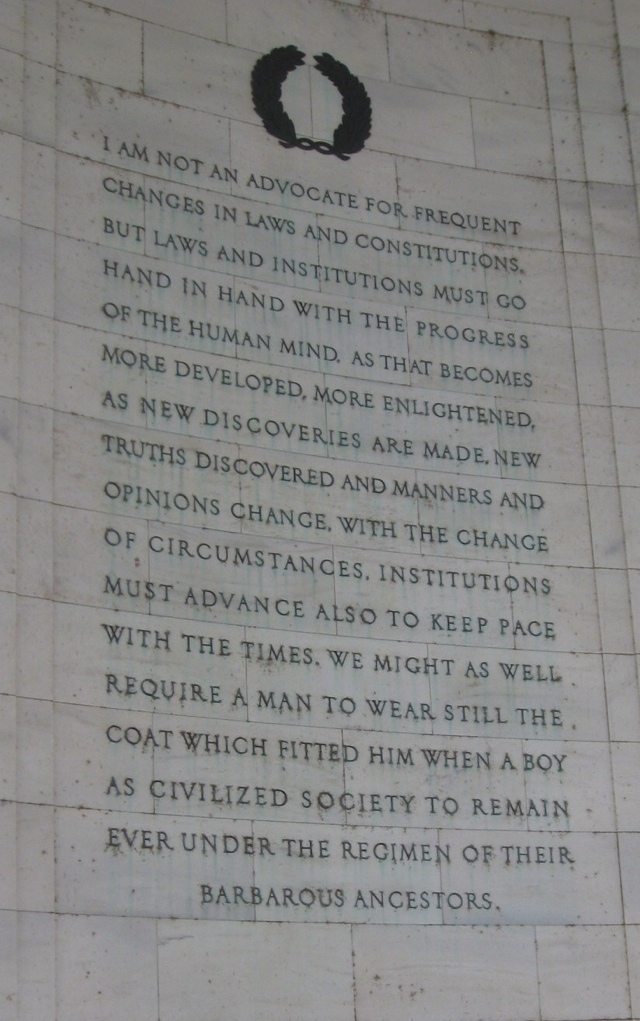
Talk of being the hapless products of our environment, of being the vassals of something bigger, of being the lucky recipients of the fruits of external systems, are all abdications of our responsibility; albeit a responsibility we wondered into unintentionally. We cannot get out of our way and everything will be alright, we have surpassed the point of no return on the evolutionary path and now we have no choice but to take up the mantle and grow into our role. I’m not sure there ever was one, but now there is no such thing as a self-directed free market that will serve our needs; our needs can only be met through intentionally directed activity. We cannot be slaves to a constitution written two hundred years ago and founded in traditions even older than that; we must accept the responsibility to develop a constitutional framework that suits our times and the nature of our modern predicament. Much of the nonsense spouted in the name of politics today is mere cowardice and ignorance in the face of an inescapable need to face up to the reality that humankind is now a partner in evolution, and not just a product of it.

Abdication in the face of necessity is not a strategy, it is pure childish folly. If you’re young enough to be pretty sure of being alive in 2030 you’d be a fool to let the mirage of ancient fallacies deter you from action any longer. And if you’re old enough to be pretty sure that you won’t be alive in 2030 you’ll go down in history as the most selfish and ignorant generation of the entire human race, if you don’t come alive to your responsibilities now and stop hiding behind the skirts of dysfunctional democracy and the hollow promises of dysfunctional economics. You are the determinant of the nature of your society and your society is the determinant of the output of your laws and your economy – take up the mantle, wake up your heart and grasp the nettle that is our common responsibility to intend our future, not accept an impoverished alternative.